8 Chapter 8 – Human Resource Management

Exhibit 8.1 (Credit: Ludovic Bertron /flickr / Attribution 2.0 Generic (CC BY 2.0))
Introduction
Learning Objectives
After reading this chapter, you should be able to answer these questions:
- What are the key laws and federal agencies affecting human resource management and labor relations?
- What is the human resource management process, and how are human resource needs determined?
- How do firms recruit applicants?
- How do firms select qualified applicants?
- What types of training and development do organizations offer their employees?
- How are performance appraisals used to evaluate employee performance?
- What are the types of compensation and methods for paying workers?
This chapter looks at the role of human resources within an organization, from the general processes of developing and planning to the more specific tasks of employee evaluation and compensation.
Human resource management and labor relations involve acquisition, development, use, and maintenance of a human resource mix (people and positions) to achieve strategic organizational goals and objectives. Successful human resource management is based on a company’s ability to attract and hire the best employees, equip them with the knowledge and skills they need to excel, compensate them fairly, and motivate them to reach their full potential and perform at high levels. Today’s business environment presents numerous challenges to effectively managing employees:
Technology continues to advance, which places great importance on knowledge workers, especially when demand outstrips the supply of high-talent individuals.
Global business operations involve rapid data transfer and necessitate accelerated decision-making by executive and technical employees.
The workforce is increasingly more diversified and multicultural, which places increased emphasis on communication and cultural understanding.
Work, life, and family priorities are more difficult to balance as dual-worker families populate the labor force.
Employment and labor laws continue to greatly influence employee recruitment and hiring, compensation decisions, and employee retention and turnover in both union and nonunion organizations.
Each day, human resource experts and front-line supervisors deal with these challenges while sharing responsibility for attracting and retaining skilled, motivated employees. Whether faced with a large or small human resources problem, supervisors need some understanding of difficult employee-relations issues, especially if there are legal implications.
In this chapter, you will learn about the elements of the human resource management process, including human resource planning and job analysis and design, employee recruitment and selection, training and development of employees, performance planning and evaluation, and compensation of the workforce.
8.1 Legal Environment of Human Resources and Labor Relations
- What are the key laws and federal agencies affecting human resource management and labor relations?
Federal laws help ensure that job applicants and employees are treated fairly and not discriminated against. Hiring, training, and job placement must be unbiased. Promotion and compensation decisions must be based on performance. These laws help all Americans who have talent, training, and the desire to get ahead. The key laws that currently impact human resource management and labor relations are listed in Table 8.1.
Several laws govern wages, pensions, and unemployment compensation. For instance, the Fair Labor Standards Act sets the federal minimum wage, which is periodically raised by Congress. Many minimum-wage jobs are found in service firms, such as fast-food chains and retail stores. The Pension Reform Act protects the retirement income of employees and retirees. Federal tax laws also affect compensation, including employee profit-sharing and stock purchase plans. When John F. Kennedy signed the Equal Pay Act into law in 1963, the goal was to stop the practice of paying women lower wages for the same job based on their gender. At the time, women with full-time jobs earned between 59 and 64 cents for every dollar their male counterparts earned in the same jobs. Although this law has been in place for several decades, progress has been slow. On April 17, 2012, President Barack Obama proclaimed National Equal Pay Day, noting that women who work full time earn only 77 cents for every dollar their male counterparts make. In 2016, the wage gap changed slightly, with women making 80.5 percent of what men earn.17
|
Laws Impacting Human Resource Management |
||
|
Law |
Purpose |
Agency of Enforcement |
|---|---|---|
|
Social Security Act (1935) |
Provides for retirement income and old-age health care |
Social Security Administration |
|
Wagner Act (1935) |
Gives workers the right to unionize and prohibits employer unfair labor practices |
National Labor Relations Board |
|
Fair Labor Standards Act (1938) |
Sets minimum wage, restricts child labor, sets overtime pay |
Wage and Hour Division, Department of Labor |
|
Taft-Hartley Act (1947) |
Obligates the union to bargain in good faith and prohibits union unfair labor practices |
Federal Mediation and Conciliation Service |
|
Equal Pay Act (1963) |
Eliminates pay differentials based on gender |
Equal Employment Opportunity Commission |
|
Civil Rights Act (1964), Title VII |
Prohibits employment discrimination based on race, color, religion, gender, or national origin |
Equal Employment Opportunity Commission |
|
Age Discrimination Act (1967) |
Prohibits age discrimination against those over 40 years of age |
Equal Employment Opportunity Commission |
|
Occupational Safety and Health Act (1970) |
Protects worker health and safety, provides for hazard-free workplace |
Occupational Safety and Health Administration |
|
Vietnam Veterans’ Readjustment Act (1974) |
Requires affirmative employment of Vietnam War veterans |
Veterans Employment Service, Department of Labor |
|
Employee Retirement Income Security Act (1974)—also called Pension Reform Act |
Establishes minimum requirements for private pension plans |
Internal Revenue Service, Department of Labor, and Pension Benefit Guaranty Corporation |
|
Pregnancy Discrimination Act (1978) |
Treats pregnancy as a disability, prevents employment discrimination based on pregnancy |
Equal Employment Opportunity Commission |
|
Immigration Reform and Control Act (1986) |
Verifies employment eligibility, prevents employment of illegal aliens |
Employment Verification Systems, Immigration and Naturalization Service |
|
Americans with Disabilities Act (1990) |
Prohibits employment discrimination based on mental or physical disabilities |
Department of Labor |
|
Family and Medical Leave Act (1993) |
Requires employers to provide unpaid leave for childbirth, adoption, or illness |
Equal Employment Opportunity Commission |
Table 8.1
Employers must also be aware of changes to laws concerning employee safety, health, and privacy. The Occupational Safety and Health Act (OSH Act) requires employers to provide a workplace free of health and safety hazards. For instance, manufacturers must require their employees working on loading docks to wear steel-toed shoes so their feet won’t be injured if materials are dropped. Drug and AIDS testing are also governed by federal laws.
Another employee law that continues to affect the workplace is the Americans with Disabilities Act. To be considered disabled, a person must have a physical or mental impairment that greatly limits one or more major life activities. More than 40 million Americans, 12.6 percent of the population, were disabled in 2015, according to the U.S. Census Bureau.18 Employers may not discriminate against disabled persons. They must make “reasonable accommodations” so that qualified employees can perform the job, unless doing so would cause “undue hardship” for the business. Altering work schedules, modifying equipment so a wheelchair-bound person can use it, and making buildings accessible by ramps and elevators are considered reasonable. Two companies often praised for their efforts to hire the disabled are McDonald’s and DuPont.
The Family and Medical Leave Act went into effect in 1993. The law guarantees continuation of paid health benefits, plus a return to the same or equivalent job, and applies to employers with 50 or more employees. It requires these employers to provide unpaid leave of up to 12 weeks during any 12-month period to workers who have been employed for at least a year and worked at least 1,250 hours during the past year. The reasons for the leave include the birth or adoption of a child; the serious illness of a child, spouse, or parent; or a serious illness that prevents the worker from doing the job.
According to the Bureau of Labor Statistics, only 11 percent of all private industry workers have access to paid family leave. Low-wage earners fare even worse. Only 5 percent of low-wage earners get any paid maternity leave, and nearly half will not take time off because they cannot afford to go without income. The United States continues to be one of only four countries in the world (along with Liberia, Suriname, and Papua New Guinea) that do not guarantee paid parental leave.19
Several federal agencies oversee employment, safety, compensation, and related areas. The Occupational Safety and Health Administration (OSHA) sets workplace safety and health standards, provides safety training, and inspects places of work (assembly plants, construction sites, and warehouse facilities, for example) to determine employer compliance with safety regulations.

Exhibit 8.2 For some occupations, danger is part of the job description. Tallies of work-related casualties routinely identify miners, loggers, pilots, commercial fishermen, and steel workers as holding the most deadly jobs. Job fatalities are often linked to the use of heavy or outdated equipment. However, many work-related deaths also happen in common highway accidents or as homicides. Pictured here are miners at the Coal Miner’s Memorial and Pennsylvania Welcome Center. What laws and agencies are designated to improve occupational safety? (Credit: Mike Steele/ Flickr/ Attribution 2.0 Generic (CC BY 2.0))
The Wage and Hour division of the Department of Labor enforces the federal minimum-wage law and overtime provisions of the Fair Labor Standards Act. Employers covered by this law must pay certain employees a premium rate of pay (or time and one-half) for all hours worked beyond 40 in one week.
The Equal Employment Opportunity Commission (EEOC) was created by the 1964 Civil Rights Act. It is one of the most influential agencies responsible for enforcing employment laws. The EEOC has three basic functions: processing discrimination complaints, issuing written regulations, and gathering and disseminating information. An employment discrimination complaint can be filed by an individual or a group of employees who work for a company. The group may comprise a protected class, such as women, African Americans, or Hispanic Americans. The protected group may pursue a class-action complaint that may eventually become a lawsuit. As a measure to prevent employment discrimination, many employers set up affirmative action programs to expand job opportunities for women and minorities
Even with affirmative action and other company efforts to follow the law, each year the EEOC receives tens of thousands of complaints from current or former employees. The monetary benefits that the EEOC wins for employees has grown substantially during the past 10 years. Large monetary settlements often occur when the EEOC files a class-action suit against an employer. For example, the Ford Motor Company settled sexual and racial harassment claims by more than 30 women for more than $10 million at two Chicago-area manufacturing plants in 2017.20 Also, Sears, Motorola, and AT&T have had to make large back-pay awards and to offer special training to minority employees after the court found they had been discriminated against.
Concept Check
- Discuss the laws that govern wages, pensions, and employee compensation.
- Describe the Americans with Disabilities Act.
8.2 Achieving High Performance through Human Resources Management
- What is the human resource management process, and how are human resource needs determined?
Human resource (HR) management is the process of hiring, developing, motivating, and evaluating employees to achieve organizational goals. The goals and strategies of the firm’s business model form the basis for making human resource management decisions. HR practices and systems comprise the firm’s human resource decision support system that is intended to make employees a key element for gaining competitive advantage. To this end, the HR management process contains the following sequenced activities:
- Job analysis and design
- Human resource planning and forecasting
- Employee recruitment
- Employee selection
- Training and development
- Performance planning and evaluation
- Compensation and benefits
The human resource management process shown in Exhibit 8.4 encourages the development of high-performance employees. The process is sequential because employees can’t be trained and paid until selected and placed in jobs, which follows recruitment, which is preceded by human resource planning and job analysis and design. Good HR practices used along this sequence foster performance improvement, knowledge and skill development, and loyal employees who desire to remain with the organization.

Exhibit 8.3 A job fair, career fair or career expo, are events in which employers, recruiters, and schools give information to potential employees and job seekers attend hoping to make a good impression to potential employers. They also interact with potential coworkers by speaking face-to-face, exchanging résumés, and asking questions in attempt to get a good feel on the work needed. Likewise, online job fairs are held, giving job seekers another way to get in contact with probable employers using the internet. How do you plan on using events like this in seeking your job? How can utilize the courses that you are taking to illustrate your skills that you can discuss at job fairs. (Credit: Taavi Burns/ flickr/ Attribution 2.0 Generic (CC BY 2.0))
HR Planning and Job Analysis and Design
Two important, and somewhat parallel, aspects of the human resource management process are determining employee needs of the firm and the jobs to be filled. When Alcon Labs gained approval from the Food and Drug Administration for sales of a new contact lens disinfectant solution in its Opti-Free product line, it had to determine if additional sales representatives were needed and whether new sales positions with different knowledge and skill requirements should be established.1 Human resource planning at Alcon means having the right number of people, with the right training, in the right jobs, to meet its sales goals for the new product. Once the need for sales representatives is determined, human resource specialists assess the skills of the firm’s existing employees to see whether new people must be hired or current people can be trained. See Exhibit 8.4 for a representation of the human resource management process.
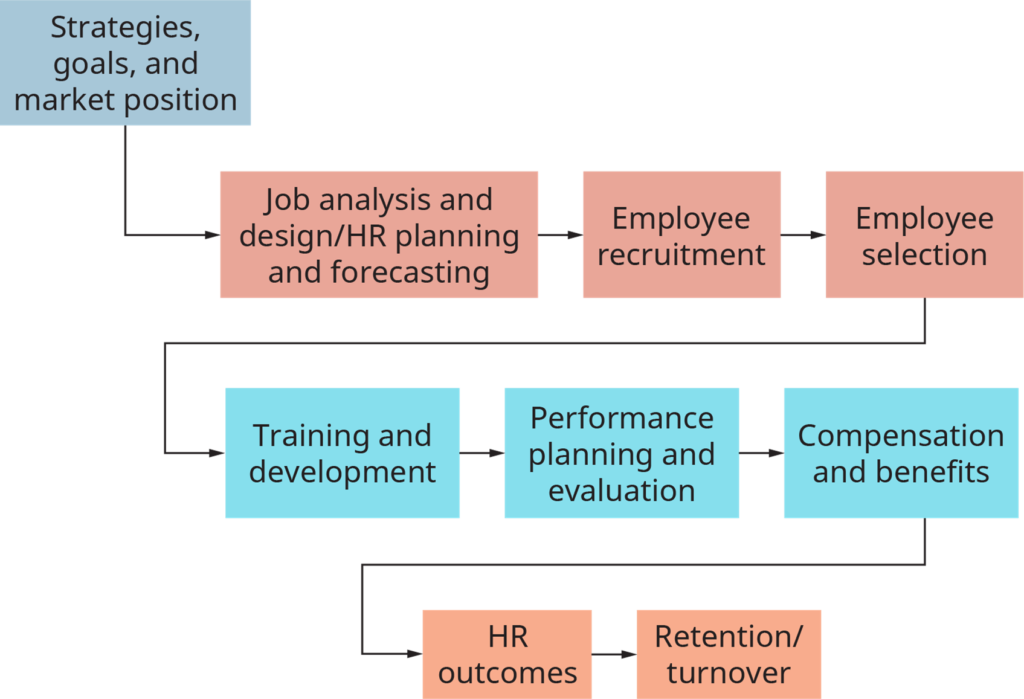
Exhibit 8.4 Human Resource Management Process (Attribution: Copyright Rice University, OpenStax, under CC BY 4.0 license.)
Human resource planners must know what skills different jobs require. Information about a specific job typically begins with a job analysis, which is a study of the tasks required to do a job well. The job Analysis is comprised of the Job Description and the Job Specifications. The tasks and responsibilities of a job are listed in a job description. The skills, knowledge, and abilities a person must have to fill a job are spelled out in a job specification. A sample job description and specification is shown in Table 8.2.
These two components help human resource planners find the right people for specific jobs, but they do more for management as well. This information is used to specify the essential skills, knowledge, and abilities required for the job. This is an internal document detailing the specifics of the job, often including a salary range. It’s used to create job postings for available positions. It also helps with the hiring process, evaluations and compensation. When Hubert Joly started as the CEO at Best Buy, the retailer was facing serious financial pressures. The threat of online competition from Amazon was real. Joly was also facing a staffing issue with a lot of turnover. He and his team instituted a plan to keep and promote staff as a core competency that would differentiate Best Buy from online retailers.2 Also, a key HR responsibility is that jobs are examined to make any changes in job duty and task responsibilities.
HR Planning and Forecasting
Forecasting an organization’s human resource needs, known as an HR demand forecast, is an essential aspect of HR planning. This process involves two forecasts: (1) determining the number of people needed by some future time (in one year, for example) and (2) estimating the number of people currently employed by the organization who will be available to fill various jobs at some future time; this is an internal supply forecast.
|
Job Description and Specification |
|
|
Position: College Recruiter Reports to: Vice President of Human |
Location: Corporate Offices Resources Classification: Salaried/Exempt |
|---|---|
|
Job Summary: |
|
|
Member of HR corporate team. Interacts with managers and department heads to determine hiring needs for college graduates. Visits 20 to 30 college and university campuses each year to conduct preliminary interviews of graduating students in all academic disciplines. Following initial interviews, works with corporate staffing specialists to determine persons who will be interviewed a second time. Makes recommendations to hiring managers concerning best-qualified applicants. |
|
|
Job Duties and Responsibilities: |
|
|
Estimated time spent and importance: |
|
|
15% |
Working with managers and department heads, determines college recruiting needs. |
|
10% |
Determines colleges and universities with degree programs appropriate to hiring needs to be visited. |
|
15% |
Performs college relations activities with numerous colleges and universities. |
|
25% |
Visits campuses to conduct interviews of graduating seniors. |
|
15% |
Develops applicant files and performs initial applicant evaluations. |
|
10% |
Assists staffing specialists and line managers in determining who to schedule for second interviews. |
|
5% |
Prepares annual college recruiting report containing information and data about campuses, number interviewed, number hired, and related information. |
|
5% |
Participates in tracking college graduates who are hired to aid in determining campuses that provide the most outstanding employees. |
|
Job Specification (Qualifications): |
|
|
Bachelor’s degree in human resource management or a related field. Minimum of two years of work experience in HR or department that annually hires college graduates. Ability to perform in a team environment, especially with line managers and department heads. Very effective oral and written communication skills. Reasonably proficient in Excel, Word, and Windows computer environment and familiar with PeopleSoft software. |
|
Table 8.2
The Advancement Planning process at Best Buy involved reducing the turnover that occurs in most retail environments. The company has achieved a second-place ranking, behind only Costco, and its general managers’ tenure at a store averages five years. The performance of managers at Best Buy is reviewed to identify people who can fill vacancies and be promoted, a process known as succession planning.3 If Best Buy has a temporary shortage of sales professionals, at the holiday shopping season, for example, they can hire an experienced contractor or interim executive as a temporary or contingent worker, someone who wants to work but not on a permanent, continuous basis. Exhibit 8.5 summarizes the process of planning and forecasting an organization’s personnel needs.
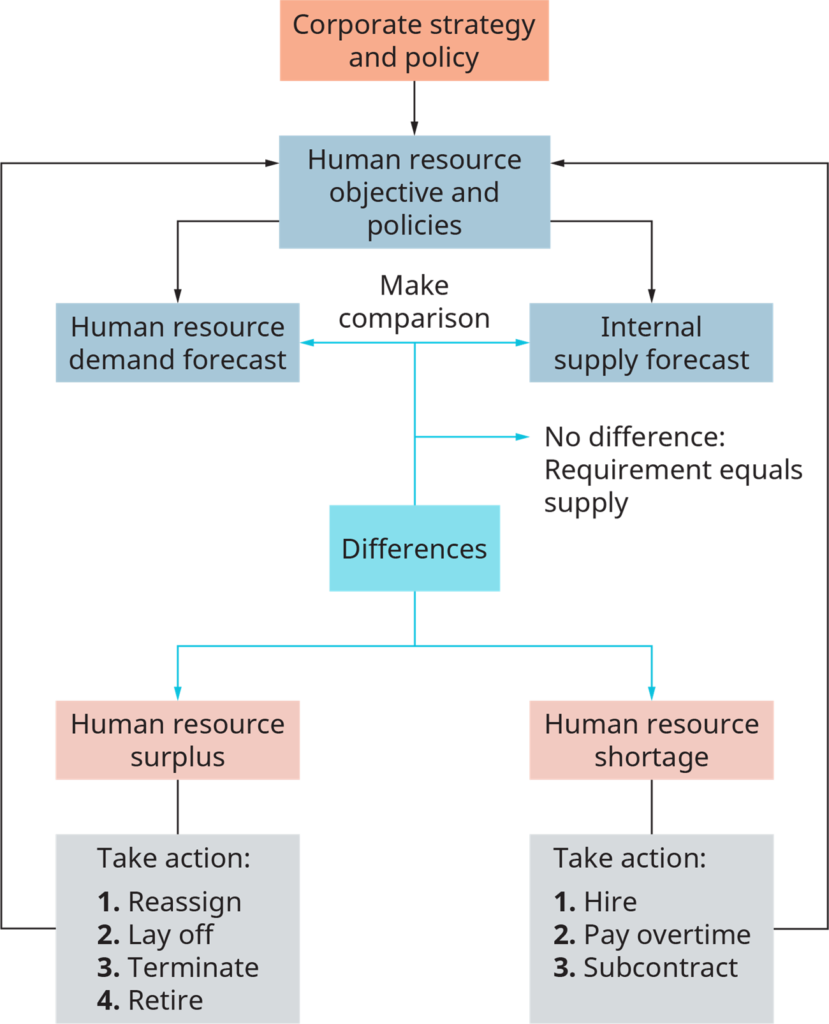
Exhibit 8.5 Human Resource Planning Process (Attribution: Copyright Rice University, OpenStax, under CC BY 4.0 license.)
Concept Check
- Define human resource management.
- Explain the job analysis; distinguish between the job description, and the job specification.
- Describe the human resource management process.
8.3 Employee Recruitment
- How do firms recruit applicants?
When a firm creates a new position or an existing one becomes vacant, the firm starts looking for people with qualifications that meet the requirements of the job. Two sources of job applicants are the internal and external labor markets. The internal labor market consists of employees currently employed by the firm; the external labor market is the pool of potential applicants outside the firm.
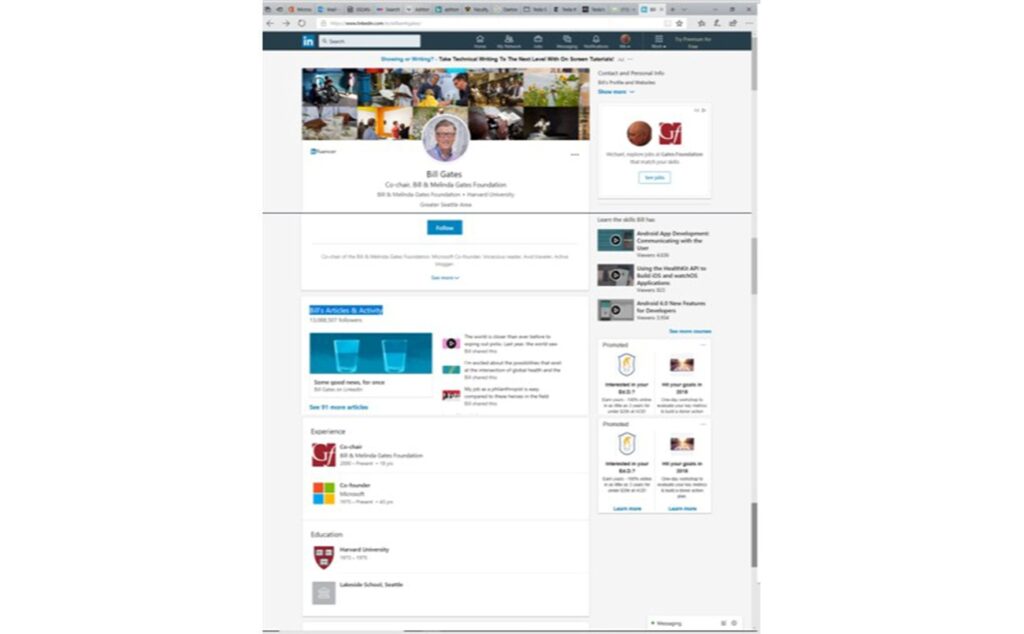
Exhibit 8.6 Online recruiting is among the top internet success stories of the past decade. LinkedIn, Monster, and CareerBuilder are hot spots for job hunters and recruiters seeking to establish a working relationship. What are the advantages and disadvantages of online recruiting compared to traditional forms of recruitment? (Credit: Bill Gates LinkedIn Profile screen capture, 3/23/2018)
Internal Labor Market
Internal recruitment can be greatly facilitated by using a human resource information system that contains an employee database with information about each employee’s previous work experience, skills, education and certifications, job and career preferences, performance, and attendance. Promotions and job transfers are the most common results of internal recruiting. BNSF Railway, Walmart, Boeing, Ritz-Carlton Hotels, and most other firms, large and small, promote from within and manage the upward mobility of their employees.
External Labor Market
The external labor market consists of prospects to fill positions that cannot be filled from within the organization. Recruitment is the process of attracting qualified people to form an applicant pool. Numerous methods are used to attract applicants, including print, radio, web, and television advertising. Hospitality and entertainment firms, such as Ritz-Carlton Hotels and Six Flags, frequently use job fairs to attract applicants. A job fair, or corporate open house, is usually a one- or two-day event at which applicants are briefed about job opportunities, given tours, and encouraged to apply for jobs. For firms needing accountants, engineers, sales managers, and others for professional and scientific positions, college recruiting is very common. These firms (Deloitte, Cisco Systems, Salesforce.com, and thousands of others) schedule job fairs and on-campus interviews with graduating seniors.
Online Recruiting and Job Search
The internet, social media, and specialized software have completely changed the employee recruitment process. Dozens of companies such as Monster.com, Indeed, StartWire, and Glassdoor enable applicants to search for job openings, post their résumés, and apply for jobs that companies have posted. Most companies provide links to their company website and to the career page on their site so applicants can learn about the company culture, listen to or read testimonials from employees about what it is like to work for the company, and search for additional openings that may interest them.
Large firms may receive thousands of online applications per month. To review and evaluate thousands of online résumés and job applications, firms depend on software to scan and track applicant materials using key words to match skills or other requirements for a particular job. Social media has also changed how companies search for applicants and verify applicant information.
Recruitment Branding
Recruitment branding involves presenting an accurate and positive image of the firm to those being recruited. Carbone Smolan Agency (CSA) is a New York–based image consulting firm that assists in developing a recruitment branding strategy.4 The materials developed by CSA comprise a realistic job preview, which informs job candidates about organizational realities of the job and the firm so they can more accurately evaluate jobs and firm expectations concerning work assignments, performance standards, promotional opportunities, company culture, and many other characteristics of the job.
Concept Check
- What are the two sources of job applicants?
- What are some methods firms use to recruit applicants?
- What is meant by recruitment branding?
8.4 Employee Selection
- How do firms select qualified applicants?
After a firm has attracted enough job applicants, employment specialists begin the selection process. Selection is the process of determining which people in the applicant pool possess the qualifications necessary to be successful on the job. The steps in the employee selection process are shown in Exhibit 8.7. An applicant who can jump over each step, or hurdle, will very likely receive a job offer; thus, this is known as the successive hurdles approach to applicant screening. Alternatively, an applicant can be rejected at any step or hurdle. Selection steps or hurdles are described below:
Initial screening. During initial screening, an applicant completes an application form and/or submits a résumé, and has a brief interview of 30 minutes or less. The job application includes information about educational background, previous work experience, and job duties performed.
Employment testing. Following initial screening, the applicant may be asked to take one or more tests, such as the Wonderlic Personnel Tests. Wonderlic offers a suite of pre-employment tests for each phase of the hiring process. Used individually or together, the tests can assess cognitive ability (ability to learn, adapt, and solve problems), motivation potential (attitude, behavior performance, and productivity), and knowledge and skills (math, verbal, data entry, software proficiency).5
HR Senior Vice President Martha LaCroix of the Yankee Candle Company uses personality assessments to make sure that prospective employees will fit the firm’s culture. LaCroix was helped by Predictive Index (PI) Worldwide in determining Yankee Candle’s best- and worst-performing store managers for developing a best practice behavioral profile of a top-performing store manager.6 The profile was used for personality testing and to develop interview questions that reveal how an applicant may behave in certain work situations.

Exhibit 8.7 Steps of the Employee Selection Process (Attribution: Copyright Rice University, OpenStax, under CC BY 4.0 license.)
Selection interview. The tool most widely used in making hiring decisions is the selection interview, an in-depth discussion of an applicant’s work experience, skills and abilities, education, and career interests. For managerial and professional positions, an applicant may be interviewed by several persons, including the line manager for the position to be filled. This interview is designed to determine a person’s communication skills and motivation. During the interview, the applicant may be presented with realistic job situations, such as dealing with a disgruntled customer, and asked to describe how they would handle the problem. Carolyn Murray of W.L. Gore & Associates (maker of Gore-Tex, among other products) listens for casual remarks that may reveal the reality behind applicant answers to her questions. Using a baseball analogy, Murray gives examples of how three job candidates struck out with her questions. See Table 8.3.7
|
Striking Out at the Interview Game |
||
|
The Pitch (Question to Applicant) |
The Swing (Applicant’s Response) |
The Miss (Interviewer’s Reaction to Response) |
|---|---|---|
|
“Give me an example of a time when you had a conflict with a team member.” |
“Our leader asked me to handle all of the FedExing for our team. I did it, but I thought that FedExing was a waste of my time.” |
“At Gore, we work from a team concept. Her answer shows that she won’t exactly jump when one of her teammates needs help.” |
|
“Tell me how you solved a problem that was impeding your project.” |
“One of the engineers on my team wasn’t pulling their weight, and we were closing in on a deadline. So I took on some of their work.” |
“The candidate may have resolved the issue for this particular deadline, but they did nothing to prevent the problem from happening again.” |
|
“What’s the one thing that you would change about your current position?” |
“My job as a salesman has become boring. Now I want the responsibility of managing people.” |
“He’s probably not maximizing his current territory, and he is complaining. Will he find his next role ‘boring’ and complain about that role, too?” |
Table 8.3
Background and reference check. If applicants pass the selection interview, most firms examine their background and check their references. In recent years, an increasing number of employers, such as American Airlines, Disney, and Microsoft, are carefully researching applicants’ backgrounds, particularly their legal history, reasons for leaving previous jobs, and even creditworthiness.
Physical exams and drug testing. A firm may require an applicant to have a medical checkup to ensure they are physically able to perform job tasks. Drug testing is common in the transportation and health care industries. Southwest Airlines, BNSF Railway, Texas Health Resources, and the U.S. Postal Service use drug testing for reasons of workplace safety, productivity, and employee health.
Decision to hire. If an applicant progresses satisfactorily through all the selection steps (or jumps all of the selection hurdles), a decision to hire the person is made; however, the job offer may be contingent on passing a physical exam and/or drug test. The decision to hire is nearly always made by the manager of the new employee.
An important aspect of employee recruitment and selection involves treating job applicants as valued customers; in fact, some applicants may be customers of the firm.
Customer Satisfaction and Quality – Puttin’ on the Ritz—For Potential Employees
Your meeting with a human resource representative is often your first exposure to the company you are applying to work for, and firms must provide good customer service to applicants if they expect to hire the most qualified employees.
Companies have several opportunities to create a positive impression of their organization during these key points in the employee selection process. These include a variety of communication channels, such as:
In-person greetings at a job fair or at the interview itself
Phone calls to a prospective employee from a human resource professional to set up the interview and any follow-up conversations between human resources and the applicant
E-mail correspondence to acknowledge receipt of an application and to thank applicants for submitting their job application
A thank-you note from the employer following the second interview
A firm that is recognized for treating prospective employees especially well is Ritz-Carlton Hotels, a subsidiary of Marriott International. When the Washington D.C. Ritz-Carlton was recruiting employees to staff a new hotel, the goal was to provide applicants with a personal demonstration of the famous Ritz-Carlton service-oriented culture.
As applicants arrived, they experienced the Ritz-Carlton “warm welcome” from several employees who greeted them, wished them luck, and escorted them past a violinist and piano player to the waiting room, where beverages and snacks were available. Applicants went through a standardized screening questionnaire, and those who passed went on to a professionally developed structured interview. Individuals were then personally escorted to the “fond farewell,” where they were thanked, given Ritz-Carlton chocolates, and escorted out of the hotel. The goal of Ritz-Carlton managers is to give applicants the same experience they would expect to receive as a customer staying in the hotel. Every applicant receives a personal, formal thank-you note for coming to the job fair, and those who are considered for positions but later rejected receive another note. Ritz-Carlton wants to make a good impression because an applicant could be a future Ritz-Carlton hotel guest, or the son or daughter of a guest.
Ritz-Carlton continues to show exemplary service during the employee orientation process. Every employee must go through seven days of training before ever working in a Ritz-Carlton. Two full days of the orientation are indoctrination in the Ritz-Carlton values and philosophy. The goal is to create a significant emotional experience for new employees during their first few days. This happens the moment new employees arrive for training at 6:00 a.m. and see senior leaders lined up outside the doors of the hotel, clapping and cheering as they greet them. The message is clear: You are important and we will treat you exactly as we want you to treat customers.
The leadership team is involved in facilitating the program, sending a powerful message about the importance of consensual commitment. “For these next few days, we will orient you to who we are—our heart, our soul, our goals, our vision, our dreams—so you can join us, and not just work for us.”
Horst Schultz, former president and COO of the Ritz-Carlton, first implemented the motto “We Are Ladies and Gentlemen Serving Ladies and Gentlemen” in the mid-1980s, and the motto is still at the heart of the company’s values today. In an address to employees, Schultz said, “You are not servants. We are not servants. Our profession is service. We are Ladies and Gentlemen, just as the guests are, who we respect as Ladies and Gentlemen. We are Ladies and Gentlemen and should be respected as such.”
Critical Thinking Questions
- What are the benefits of an employer treating a job applicant like a customer? Are there costs associated with treating applicants poorly?
- What is the Ritz-Carlton motto? How does it teach both applicants and employees about the company’s values?
Sources: “Gold Standards,” http://www.ritzcarlton.com, accessed February 8, 2018; “Lifetime Learning Opportunities,” http://www.marriott.com, accessed February 8, 2018; Justin Hoffman, “Secrets of the Ritz-Carlton’s ‘Legendary’ Customer Service,” https://www.psafinancial.com, May 8, 2014; Sandra J. Sucher and Stacy McManus, “The Ritz-Carlton Hotel Company,” Harvard Business School Case #601-163, March 2001; revised September 2005.
Concept Check
- Describe the employee selection process.
- What are some of the ways that prospective employees are tested?
8.5 Employee Training and Development
- What types of training and development do organizations offer their employees?
To ensure that both new and experienced employees have the knowledge and skills to perform their jobs successfully, organizations invest in training and development activities. Training and development involves learning situations in which the employee acquires additional knowledge or skills to increase job performance. Training objectives specify performance improvements, reductions in errors, job knowledge to be gained, and/or other positive organizational results. The process of creating and implementing training and development activities is shown in Exhibit 8.9. Training is done either on the job or off the job.

Exhibit 8.8 Here is the final assembly process on an Boeing 787-10 for Singapore Airlines. This plant is one of Boeing’s largest and most technologically advanced manufacturing facilities, in Charleston, South Carolina. How is technology helping companies develop skilled workers both on and off the job? (Credit: https://upload.wikimedia.org/wikipedia/commons/thumb/c/c0/Singapore_Airlines_787-10_final_assembly_%2841008876271%29.jpg/220px-Singapore_Airlines_787-10_final_assembly_%2841008876271%29.jpg)
On-the-Job Training
New-employee training is essential and usually begins with orientation, which entails getting the new employee ready to perform on the job. Formal orientation (often a half-day classroom program) provides information about the company history, company values and expectations, policies, and the customers the company serves, as well as an overview of products and services. More important, however, is the specific job orientation by the new employee’s supervisor concerning work rules, equipment, and performance expectations. This second briefing tends to be more informal and may last for several days or even weeks.
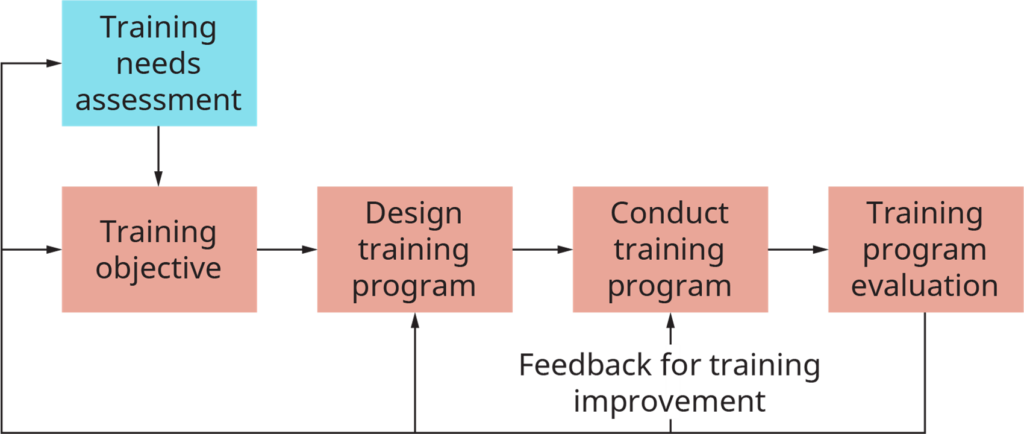
Exhibit 8.9 Employee Training and Development Process (Attribution: Copyright Rice University, OpenStax, under CC BY 4.0 license.)
Beyond employee orientation, job training takes place at the job site or workstation and is directly related to the job. This training involves specific job instruction, coaching (guidance given to new employees by experienced ones), special project assignments, or job rotation. Job rotation is the reassignment of workers to several different jobs over time. At Walmart, management trainees rotate through three or more merchandizing departments, customer service, credit, and even the human resource department during the first year or two on the job.
Two other forms of on-the-job training are apprenticeship and mentoring. An apprenticeship usually combines specific on-the-job instruction with classroom training. It may last as long as four years and can be found in the skilled trades of carpentry, plumbing, and electrical work. Mentoring involves a senior manager or other experienced employee providing job- and career-related information to a mentee. Inexpensive and providing instantaneous feedback, mentoring is becoming increasingly popular with many firms, including FedEx, Merrill Lynch, Dow Chemical, and Bank of America. Whereas mentoring is typically conducted through ongoing face-to-face interactions between mentor and mentee, technology now allows for a long-distance mentoring relationship. Dow Chemical uses e-mail and video conferencing to facilitate long-distance mentoring between persons who are working in different countries. For a mentee whose second language is English, writing e-mail messages in English helps the individual become fluent in English, which is a requirement of all Dow Chemical employees regardless of location and country of origin.8
Off-the-Job Training
Even with the advantages of on-the-job training, many firms recognize that it is often necessary to train employees away from the workplace. With off-the-job training, employees learn the job away from the job. There are numerous popular methods of off-the-job training. It frequently takes place in a classroom, where cases, role-play exercises, films, videos, lectures, and computer demonstrations are used to develop workplace skills.
Web-based technology is increasingly being used along with more traditional off-the-job training methods. E-learning and e-training involve online computer presentation of information for learning new job tasks. Union Pacific Railroad has tens of thousands of its employees widely dispersed across much of the United States, so it delivers training materials online to save time and travel costs. Technical and safety training at Union Pacific are made available as programmed instruction, an online, self-paced, and highly structured training method that presents trainees with concepts and problems using a modular format. Software provided can make sure that employees receive, undergo, and complete, as well as sign off on, various training modules.9
Web-based training can also be done using a simulation, for example, a scaled-down version of a manufacturing process or even a mock cockpit of a jet airplane. American Airlines uses a training simulator for pilots to practice hazardous flight maneuvers or learn the controls of a new aircraft in a safe, controlled environment with no passengers. The simulator allows for more direct transfer of learning to the job.
Concept Check
- Describe several types of on-the-job training.
- What are the advantages of simulation training?
- How is technology impacting off-the-job training?
8.6 Performance Planning and Evaluation
- How are performance appraisals used to evaluate employee performance?
Along with employee orientation and training, new employees learn about performance expectations through performance planning and evaluation. Managers provide employees with expectations about the job. These are communicated as job objectives, schedules, deadlines, and product and/or service quality requirements. As an employee performs job tasks, the supervisor periodically evaluates the employee’s efforts. A performance appraisal is a comparison of actual performance with expected performance to determine an employee’s contributions to the organization and to make decisions about training, compensation, promotion, and other job changes. The performance planning and appraisal process is shown in Exhibit 8.10 and described below.
- The manager establishes performance standards.
- The employee works to meet the standards and expectations.
- The employee’s supervisor evaluates the employee’s work in terms of quality and quantity of output and various characteristics such as job knowledge, initiative, relationships with others, and attendance and punctuality.
- Following the performance evaluation, reward (pay raise) and job change (promotion) decisions can be made. If work is unsatisfactory, the employee may be put on a performance improvement plan, which outlines the behaviors or performance that must be improved, the milestones and time periods to improve performance, and what will occur if performance is not improved.
- Rewards are positive feedback and provide reinforcement, or encouragement, for the employee to continue improving their performance.
It was once common practice for performance appraisals to be conducted on an annual basis, but most companies have moved away from that standard. Instead, managers are encouraged to provide employees with continuous real-time feedback so that skill development and job performance can be improved more rapidly.
Information for performance appraisals can be assembled using rating scales, supervisor logs of employee job incidents, and reports of sales and production statistics. Regardless of the source, performance information should be accurate and a record of the employee’s job behavior and efforts. Table 8.4 illustrates a rating scale for one aspect of a college recruiter’s job. A rating of “9” is considered outstanding job behavior and performance; a rating of “1” is viewed as very poor to unacceptable.
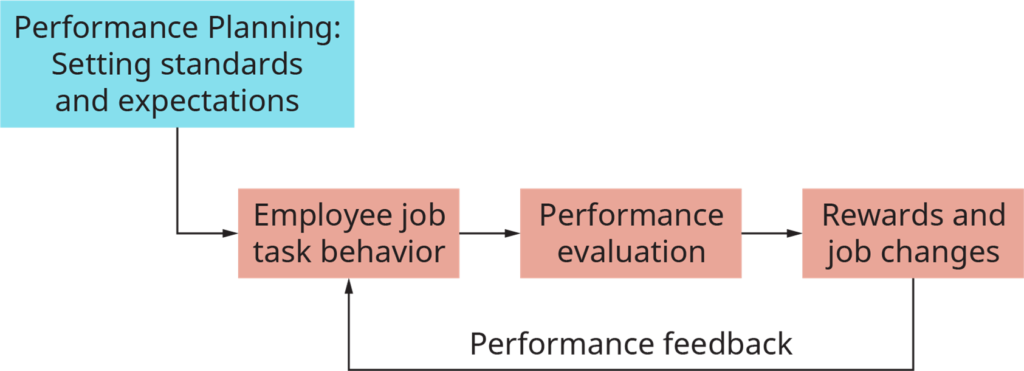
Exhibit 8.10 Performance Planning and Evaluation
|
Example of Behavior-Based Rating Scale for Performance Appraisal |
||
|
Position: College Recruiter |
||
|
Job Description: Visits campuses and conducts interviews of graduating seniors |
||
|
Explanation of Rating |
Performance Rating |
Explanation of Rating |
|---|---|---|
|
This recruiter plans and organizes spring-semester college-recruiting schedule to minimize travel expenses and maximize the number of colleges visited and students interviewed. |
9 |
|
|
|
8 |
Even with tight travel schedules between campuses, this recruiter completes each campus report before arrival at next campus. |
|
|
7 |
In making plans to visit a new campus, this recruiter might not have identified two or three faculty |
|
|
6 |
members for obtaining pre-visit information about degree programs. |
|
This recruiter occasionally does not check with college placement office to request student résumés two days before arrival. |
5 |
|
|
|
4 |
Sometimes this recruiter’s notes are incomplete concerning a student’s response to interview questions. |
|
|
3 |
This recruiter is often several minutes late in starting interviews. |
|
This recruiter is frequently late in sending thank-you letters to students interviewed. |
2 |
|
|
|
1 |
This recruiter is always late completing campus-recruiting reports. |
Table 8.4
Concept Check
- What are the steps in the performance planning and appraisal process?
- What purposes do performance appraisals serve?
- Describe some sources of information for the performance appraisal.
8.7 Employee Compensation and Benefits
- What are the types of compensation and methods for paying workers?
Compensation, which includes both pay and benefits, is closely connected to performance appraisals. Employees who perform better tend to get bigger pay raises. Several factors affect an employee’s pay:
Pay structure and internal influences. Wages, salaries, and benefits are based on skills, experience, and the level of the job. The most important high-level positions, such as president, chief information officer, and chief financial officer, are compensated at the highest rates. Likewise, different jobs of equal importance to the firm are compensated at similar rates. As the level of management responsibility increases, so does pay. For instance, if a drill-press operator and a lathe operator are considered of equal importance, they may both be paid $21 per hour.
Pay level and external influences. In deciding how much to pay workers, the firm must also be concerned with the salaries paid by competitors. If competitors are paying higher wages, a firm may lose its best employees. HR professionals regularly evaluate salaries by geography, job position, and competitor and market wages. Wage and salary surveys conducted by the U.S. Chamber of Commerce and the U.S. Department of Labor can also be useful. There are also several websites such as Glassdoor that post salaries for jobs by company.
An employer can decide to pay at, above, or below the going rate. Most firms try to offer competitive wages and salaries within a geographic area or an industry. If a company pays below-market wages, it may not be able to hire skilled people. The level of a firm’s compensation is determined by the firm’s financial condition (or profitability), efficiency, and employee productivity, as well as the going rates paid by competitors. For example, MillerCoors Brewing Co. is considered a high-paying firm ($29–$33 per hour for production employees).10
Types of Compensation or Pay
There are two basic types of compensation: direct and indirect. Direct pay is the wage or salary received by the employee; indirect pay consists of various employee benefits and services. Employees are usually paid directly on the basis of the amount of time they work, the amount they produce, the type of work performed, or some combination of skill, time, and output. An hourly rate of pay or a monthly salary is considered base pay, or an amount of pay received by the employee regardless of output level. In many jobs, such as sales and manufacturing, an employee can earn additional pay as a result of a commission or an incentive pay arrangement. The accelerated commission schedule for a salesperson shown below indicates that as sales increase the incentive becomes increasingly more attractive and rewarding; therefore, pay can function as a powerful motivator. In this example, a salesperson receives a base monthly salary of $1,000, then earns 3 percent on the first $50,000 of product sold, 4 percent on the next $30,000, and 5 percent on any sales beyond $80,000.
|
Base pay |
$1,000 per month |
|---|---|
|
3% of 50,000 |
1,500 |
|
4% of 30,000 |
1,200 |
|
5% of 20,000 |
1,000 |
|
|
$4,700 |
Two other incentive pay arrangements are bonuses and profit-sharing. Employees may be paid bonuses for reaching certain monthly or annual performance goals or achieving a specific cost-saving objective. In this instance, employees are rewarded based on achieving certain goals.
In a profit-sharing plan, employees may receive some portion of the firm’s profit. Employee profit shares are usually based on annual company financial performance and therefore are paid once a year. With either a bonus or a profit share, an important incentive pay consideration is whether the bonus or profit share is the same for all employees or whether it is differentiated by level in the organization, base pay, or some other criterion. Choice Homes, a large-scale builder of starter homes, pays an annual incentive share that is the same for everyone; the president receives the same profit share or bonus as the lowest-paid employee.
Indirect pay includes pensions, health insurance, vacation time, and many others. Some forms of indirect pay are required by law: unemployment compensation, worker’s compensation, and Social Security, which are all paid in part by employers. Unemployment compensation provides former employees with money for a certain period while they are unemployed. To be eligible, the employee must have worked a minimum number of weeks, be without a job, and be willing to accept a suitable position offered by the state Unemployment Compensation Commission. Some state laws permit payments to strikers. Worker’s compensation pays employees for lost work time caused by work-related injuries and may also cover rehabilitation after a serious injury. Social Security is mainly a government pension plan, but it also provides disability and survivor benefits and benefits for people undergoing kidney dialysis and transplants. Medicare (health care for seniors) and Medicaid (health care for the poor) are also part of Social Security.
Many employers also offer benefits not required by law. Among these are paid time off (vacations, holidays, sick days, even pay for jury duty), health insurance (including dental and vision), supplemental benefits (disability, life, pet insurance, legal benefits), 401K contributions, pensions and retirement savings accounts, and stock purchase options.
Some firms with numerous benefits allow employees to mix and match benefit items or select items based on individual needs. A younger employee with a family may desire to purchase medical, disability, and life insurance, whereas an older employee may want to put more benefit dollars into a retirement savings plan. Pay and benefits are obviously important elements of human resource management and are frequently studied as aspects of employee job satisfaction. Pay can be perceived as very satisfactory, or it can be a point of job dissatisfaction. In a study of job satisfaction conducted by SAP, direct compensation was the most important element of job satisfaction by employees from various companies.11 As the cost of health insurance and other benefits has risen sharply over the past few years, benefits have become increasingly important to workers.
Catching the Entrepreneurial Spirit
Starbucks Perks More Than Coffee
At Starbucks, CEO Howard Schultz understood that the single most important aspect of creating an enduring brand is its people. Schultz wanted to set Starbucks apart from other coffee shops and service businesses, and he did this by offering health benefits and stock ownership for people who work part-time. It had never been done before, and it came with a cost.
In addition to employee benefits, funding to build the brand was funneled into operations to create an experience that would enable the brand to endure and be sold profitably for many years to come. So instead of expensive marketing and advertising campaigns, the company focused on experiential marketing.
Scott Bedbury, the president of marketing of Starbucks at the time, explains. “The stores were once four white walls. There was no comfortable furniture or fireplaces or music. So we set out to create an experience in the stores and a level of brand equity that most traditionally marketed brands couldn’t touch. That meant constant creative development of products, and the look and feel in the stores. It wasn’t cheap. The first year, we spent $100 million building out stores, which is a significant marketing budget for anyone.”
But the defining moment for the brand was the stock option and employee benefit plan. This laid the foundation for the company’s internal brand, and was Schultz’s mission from the very beginning, explains Bedbury. “When Howard took over the company, he was not a rich man and he didn’t own a house or even a car. Howard grew up poor in Brooklyn and was influenced strongly by his dad, who never got health benefits from any of his employers. This fueled Howard’s drive to create a company that put employees first. He is passionate that when it comes to customers versus employees, employees will always come first.”
But it wasn’t easy, and it took a lot of courage to present this idea to investors. Bedbury said, “When Howard tried to raise $2.8 million to buy the company from the three founders, he made 220 presentations and he got shut down in all but 12 of them. He was seen as an idealist who was going to put an unnecessary burden on the bottom line by offering benefits to part-time employees who viewed this as a temporary job. But Howard convinced them that turnover would drop, which it did. Store manager attrition was 15 percent, part-time hourly employees was 65 percent, compared to McDonalds and Taco Bell, which were about 200–300 percent a year. That’s turning over your work force every four months, and when you do that, your service suffers and there are all kinds of problems. I don’t know why more people don’t do it. If you give up some equity to employees, they’ll reward you for that.”
Critical Thinking Questions
- How can a company like Starbucks sustain its strong employee culture while continuing to grow rapidly?
- Can a firm give its employees too much in terms of benefits and services? Explain.
Sources: Blog, MarketSmarter, http://www.marketsmarter.com/blog, accessed March 12, 2018; Carmine Gallo, “How Starbucks CEO Howard Schultz Inspired Us to Dream Bigger,” Forbes, https://www.forbes.com, December 2, 2016; Tanza Loudenback, “The Story Behind the Rise of Starbucks’ Howard Shultz, Who Just Gave a Raise to Every US Employee of His $82 Billion Coffee Company,” Business Insider, http://www.businessinsider.com, July 11, 2016; Monique Reece, Real-Time Marketing for Business Growth (Upper Saddle River, NJ: FT Press/Pearson, 2010).
Concept Check
- How does a firm establish a pay scale for its employees?
- What is the difference between direct and indirect pay?
- Why are health insurance and benefits so important to employees?
Influencing Employee Performance and Motivation
How do companies use rewards strategies to influence employee performance and motivation?
Both performance management and rewards systems are key levers that can be used to motivate and drive individual and group performance … which leads to overall organizational performance, productivity, and growth. Performance and rewards systems are also “cultural” in that they provide a glimpse into the way a company manages the performance (or nonperformance) of its employees, and to what extent they are willing to differentiate and reward for that performance. There has been a great deal of discussion over the years to identify best practices in the ways we differentiate and reward employees, which will also drive employee performance and motivation.
Before we can talk about best practices and findings in rewards and motivation systems, we must first define the terms. Rewards systems are the framework that an organization (generally via human resources) creates and manages to ensure that employee performance is reciprocated with some sort of reward (e.g., monetary or other extrinsic) that will drive and motivate the employee to continue to perform for the organization. Rewards programs consist primarily of compensation programs and policies, but can also include employee benefits and other extrinsic rewards that fulfill employee needs.
Within human resource management, the primary focus of a rewards program in an organization is to successfully implement a compensation system. Most organizations strive to implement a pay-for-performance compensation program that offers competitive pay in the marketplace and allows differentiation of compensation based on employee performance. Pay for performance begins with a philosophy that an organization adopts that states that they seek to reward the best-performing employees to enhance business performance and take care of those who can have the greatest impact.
In the 2011 SHRM article by Stephen Miller, entitled “Study: Pay for Performance Pays Off,” Miller says that companies’ top four drivers for moving to a pay-for-performance strategy are to:
- Recognize and reward high performers (46.9%)
- Increase the likelihood of achieving corporate goals (32.5%)
- Improve productivity (7.8%)
- Move away from an entitlement culture (7.8%)
The study also showed that the drivers differed depending on whether the company was high performing or lower performing.6 Almost half of high-performing organizations indicated that recognizing and rewarding top performers was the main driver of their pay-for-performance strategy, making it number one on the list of primary drivers. Lower-performing organizations did not appear to be as sure about the drivers behind their strategy. The number one driver among this group was achieving corporate goals. It appears that those top-performing organizations that implement a pay-for-performance strategy truly believe in the idea of differentiating among different levels of performance.
According to the 2015 World at Work “Compensation Programs and Practices Report,” pay for performance continues to thrive with better than 7 in 10 (72%) companies saying that they directly tie pay increases to job performance, and two-thirds (67%) indicating increases for top performers are at least 1.5 times the increase for average performers. In addition, the results of the survey seem to indicate that employees’ understanding of the organization’s compensation philosophy improves when there is higher differentiation in increases between average and top performers. The greater differentiation of increases is more visible and drives home the point that the company is serious about pay for performance.7
Human resource management professionals play a key role in the rewards processes, and employee compensation is only one piece (although a key piece!) of the “total rewards” pie. World at Work defines total rewards as a “dynamic relationship between employers and employees.” World at Work also defines a total rewards strategy as the six elements of total rewards that “collectively define an organization’s strategy to attract, motivate, retain and engage employees.” These six elements include:
Compensation—Pay provided by an employer to its employees for services rendered (i.e., time, effort, and skill). This includes both fixed and variable pay tied to performance levels.
Benefits—Programs an employer uses to supplement the cash compensation employees receive. These health, income protection, savings, and retirement programs provide security for employees and their families.
Work-life effectiveness—A specific set of organizational practices, policies, and programs, plus a philosophy that actively supports efforts to help employees achieve success at both work and home.
Recognition—Formal or informal programs that acknowledge or give special attention to employee actions, efforts, behavior, or performance and support business strategy by reinforcing behaviors (e.g., extraordinary accomplishments) that contribute to organizational success.
Performance management—The alignment of organizational, team, and individual efforts toward the achievement of business goals and organizational success. Performance management includes establishing expectations, skill demonstration, assessment, feedback, and continuous improvement.
Talent development—Provides the opportunity and tools for employees to advance their skills and competencies in both their short- and long-term careers.
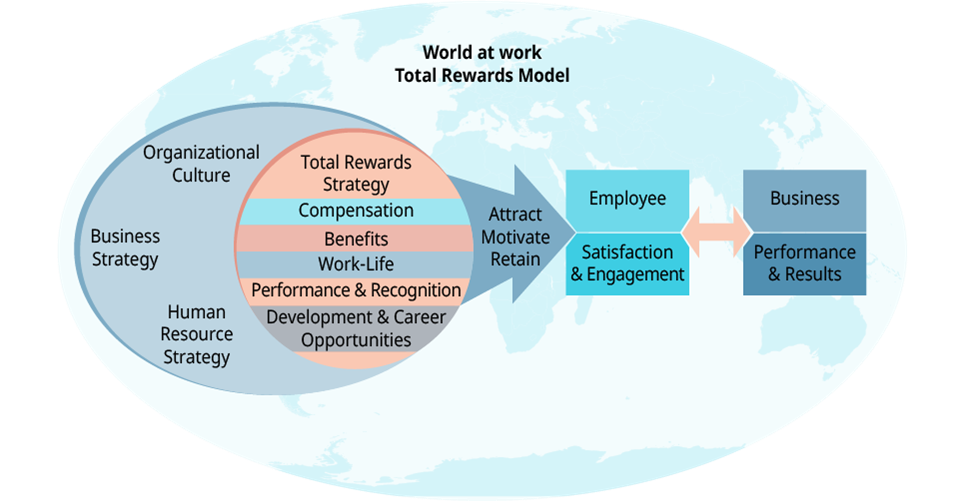
Exhibit 8.10 Total Rewards Model, World at Work (Attribution: Copyright Rice University, OpenStax, under CC-BY 4.0 license)
Human resource management is responsible for defining and driving the various elements of an organization’s total rewards strategy and ensuring that it is engaging enough to attract and retain good employees. It is easy to see that there are many different types of rewards that can motivate individuals for many different reasons, something we’ll discuss more in Motivation!
Within human resource management, the area of compensation and reward systems is exceedingly complicated. In organizations, we think primarily of compensation rewards, which are very important drivers and motivators for most people. We need to also remember the other aspects of the total rewards strategy, as well as the drives and levers we can utilize to motivate employees.
Concept Check
- What does a pay-for-performance strategy mean for a company?
- What is the first step in defining an organization’s pay-for-performance strategy?
Key Terms
affirmative action programs
Programs established by organizations to expand job opportunities for women and minorities.
apprenticeship
A form of on-the-job training that combines specific job instruction with classroom instruction.
competitive advantage
A set of unique features of an organization that are perceived by customers and potential customers as significant and superior to the competition.
contingent worker
Person who prefers temporary employment, either part-time or full-time.
Equal Employment Opportunity Commission (EEOC)
Processes discrimination complaints, issues regulations regarding discrimination, and disseminates information.
human resource (HR) management
The process of hiring, developing, motivating, and evaluating employees to achieve organizational goals.
human resource planning
Creating a strategy for meeting current and future human resource needs.
incentive pay
Additional pay for attaining a specific goal.
job analysis
A study of the tasks required to do a particular job well.
job description
The tasks and responsibilities of a job.
job fair
An event, typically one or two days, held at a convention center to bring together job seekers and firms that are searching for employees.
job rotation
Reassignment of workers to several different jobs over time so that they can learn the basics of each job.
job specification
A list of the skills, knowledge, and abilities a person must have to fill a job.
mediation
Negotiation process in which a specialist facilitates labor-management contract discussions and suggests compromises.
mentoring
A form of on-the-job training in which a senior manager or other experienced employee provides job- and career-related information to a mentee.
Occupational Safety and Health Administration (OSHA)
Sets workplace safety and health standards and assures compliance.
orientation
Presentation to get the new employee ready to perform his or her job.
performance appraisal
A comparison of actual performance with expected performance to assess an employee’s contributions to the organization.
programmed instruction
A form of computer-assisted off-the-job training.
protected classes
The specific groups who have legal protection against employment discrimination; include women, African-Americans, Native Americans, and others.
recruitment
The attempt to find and attract qualified applicants in the external labor market.
recruitment branding
Presenting an accurate and positive image of the firm to those being recruited.
selection
The process of determining which persons in the applicant pool possess the qualifications necessary to be successful on the job.
selection interview
An in-depth discussion of an applicant’s work experience, skills and abilities, education, and career interests.
simulation
A scaled-down version or mock-up of equipment, processes, or a work environment.
succession planning
Examination of current employees to identify people who can fill vacancies and be promoted.
training and development
Activities that provide learning situations in which an employee acquires additional knowledge or skills to increase job performance.
unemployment compensation
Government payment to unemployed former workers.
worker’s compensation
Pay for lost work time due to employment-related injuries.
Summary of Learning Outcomes
8.1 Legal Environment of Human Resources and Labor Relations
What are the key laws and federal agencies affecting human resource management and labor relations?
A number of federal laws affect human resource management. Federal law prohibits discrimination based on age, race, gender, color, national origin, religion, or disability. The Americans with Disabilities Act bans discrimination against disabled workers and requires employers to change the work environment to accommodate the disabled. The Family and Medical Leave Act requires employers, with certain exceptions, to provide employees up to 12 weeks of unpaid leave a year. The leave can be for the birth or adoption of a child or due to serious illness of the worker or a family member.
Federal agencies that deal with human resource administration are the EEOC, OSHA, the Office of Federal Contract Compliance Programs (OFCCP), and the Wage and Hour Division of the Department of Labor. The EEOC and OFCCP are primary agencies for the enforcement of employment discrimination laws, OSHA enforces safety regulations, and the Wage and Hour Division enforces the minimum wage and related laws. Many companies employ affirmative action and safety officers to ensure compliance with antidiscrimination and workplace safety laws. The Wagner and Taft-Hartley Acts govern the union-management relationship, in part through the functions performed by the National Labor Relations Board. The law gives workers the right to form and join labor unions and obligates the employer to deal with the union fairly.
8.2 Achieving High Performance through Human Resources Management
What is the human resource management process, and how are human resource needs determined?
The human resource management process consists of a sequence of activities that begins with the job analysis and HR planning; progresses to employee recruitment and selection; then focuses on employee training, performance appraisal, and compensation; and ends when the employee leaves the organization.
Creating a strategy for meeting human resource needs is called human resource planning, which begins with the job analysis. Job analysis is a process of studying a job to determine its tasks and duties for setting pay, determining employee job performance, specifying hiring requirements, and designing training programs. Information from the job analysis is used to prepare a job description, which lists the tasks and responsibilities of the job. A job specification describes the skills, knowledge, and abilities a person needs to fill the job described in the job description. By examining the human resource demand forecast and the internal supply forecast, human resource professionals can determine if the company faces a personnel surplus or shortage.
8.3 Employee Recruitment
How do firms recruit applicants?
When a job vacancy occurs, most firms begin by trying to fill the job from within the ranks of their own employees, known as the internal labor market. If a suitable internal candidate is not available, the firm turns to the external labor market. Firms use local media to recruit nontechnical, unskilled, and nonsupervisory workers. To locate highly trained recruits, employers use college recruiters, executive search firms, job fairs, and company websites to promote job openings. During the job search process, firms present an accurate and positive image of the company to those being recruited, called recruitment branding.
8.4 Employee Selection
How do firms select qualified applicants?
The selection process helps identify the candidates in the applicant pool who possess the best qualifications for the open position. Typically, an applicant submits an application or résumé and then receives a short, structured interview. If an applicant makes it past the initial screening, he or she may be asked to take an aptitude, personality, or skills test. The next step is the selection interview, which is an in-depth discussion of the applicant’s work experience, skills and abilities, education, and career interests. If the applicant passes the selection interview, most firms conduct background checks and talk with their references. Physical exams and drug testing may also be part of the selection process.
8.5 Employee Training and Development
What types of training and development do organizations offer their employees?
Training and development programs are designed to increase employees’ knowledge, skills, and abilities in order to foster job performance improvements. Formal training (usually classroom in nature and off-the-job) takes place shortly after being hired. Development programs prepare employees to assume positions of increasing authority and responsibility. Job rotation, executive education programs, mentoring, and special-project assignments are examples of employee development programs.
8.6 Performance Planning and Evaluation
How are performance appraisals used to evaluate employee performance?
A performance appraisal compares an employee’s actual performance with the expected performance. Performance appraisals serve several purposes, but are typically used to determine an employee’s compensation, training needs, and advancement opportunities.
8.7 Employee Compensation and Benefits
What are the types of compensation and methods for paying workers?
Direct pay is the hourly wage or monthly salary paid to an employee. In addition to the base wage or salary, direct pay may include bonuses and profit shares. Indirect pay consists of various benefits and services. Some benefits are required by law and include unemployment compensation, worker’s compensation, and Social Security. Many employers also offer benefits not required by law. These include paid vacations and holidays, pensions, health and other insurance, employee wellness programs, and college tuition reimbursement.
Management Skills Application Exercises
The benefits package of many employers includes numerous items such as health insurance, life insurance, 401(k) plan, paid vacations, tuition reimbursement, employee price discounts on products of the firm, and paid sick leave. At your age, what are the three or four most important benefits? Why? Twenty years from now, what do you think will be your three or four most important benefits? Why? (Resources)
Go to the government documents section in your college or university library, and inspect publications of the Department of Labor (DOL), including Employment and Earnings, Compensation and Working Conditions, Monthly Labor Review, Occupational Outlook Handbook, and Career Guide to Industries. Alternatively, go to the DOL Bureau of Labor Statistics website at http://stats.bls.gov. Access the most recent DOL publications and locate the following information. (Information)
Number of persons in the American workforce
Unemployment rate for last year
Demographic characteristics of the American workforce: race, ethnic status, age, marital status, and gender
Occupations where there are projected shortages for the next five or 10 years
Critical Thinking Case
Discrimination in the Workplace Continues
Although we live in enlightened times, a recent Gallup Poll found that 15 percent of American workers still experienced some form of workplace discrimination. The study was conducted to mark the anniversary of the Civil Rights Act of 1964 and the creation of the EEOC.
The poll found that the two most frequently cited types of discrimination are sexual discrimination (31 percent) and discrimination based on race or ethnicity (36 percent). Also mentioned were age, disability, sexual orientation, and religion. The work areas found to be most susceptible to discrimination are promotion and pay. Being selected for a job and treatment in the workplace were also cited. Wage discrimination and sexual harassment are two big battles women continue to fight. Both topics were in the headlines in 2017; one took center stage and the other was brushed under the covers (at least for now).
Thanks to Harvey Weinstein, the topic of sexual harassment was in the spotlight, setting off a tsunami as women around the world reacted with their #MeToo stories. As the movement progressed from Hollywood, to media companies, to Capitol Hill, and finally into corporate America, the topic had a platform. From the boardroom to the factory floor, women who had been sexually harassed shared their stories.
As companies rushed to put zero-tolerance policies into place and issue new training requirements, lawsuits and class-action cases were settled more quickly, some very publicly. In August 2017, the EEOC reached a $10 million settlement with Ford motor company for sexual and racial harassment at two Chicago plants.
In contrast, little was reported on the reversal of the new regulation designed to combat the wage gap between men and women. The revised EEO-1 would have gone into effect March 31, 2018, and required companies with 100 or more employees and federal contractors with 50 or more employees to report W-2 wage information and total hours worked for all employees. The EEO-1 form already requires employers to report data on race/ethnicity and gender.
The Office of Management and Budget (OMB) initiated a review and immediate stay to the U.S. EEOC “in accordance with its authority under the Paperwork Reduction Act (PRA),” reversing the regulation that had been revised on September 29, 2016.
Pay equity advocates who had supported expanded pay-data reporting were critical of the suspension. “We see through the Trump administration’s call to halt the equal pay rule that requires employers to collect and submit pay data by gender, race, and ethnicity to the government,” said Fatima Goss Graves, president and CEO of the National Women’s Law Center in Washington, D.C. “Make no mistake—it’s an all-out attack on equal pay. [It] sends a clear message to employers: if you want to ignore pay inequities and sweep them under the rug, this administration has your back.”
How important is equal pay? According to the analyses of the 2014–2016 Annual Social and Economic supplement published by the Institute for Women’s Policy Research, the United States economy would have produced additional income of $512.6 billion if women received equal pay; this represents 2.8 percent of 2016 gross domestic product (GDP).
In addition, poverty rates would drop from 10.8 percent to 4.4 percent, and the number of children with working mothers living in poverty would be nearly cut in half, dropping from 5.6 million to 3.1 million.
Critical Thinking Questions
- Why is workplace diversity so important in today’s business environment?
- What are the major sources of workplace discrimination? Cite specific examples from the case.
- What steps are companies taking to ensure that employees are not discriminated against?
Sources: Susan Chira and Catrin Einhorn, “How Tough Is It to Change a Culture of Harassment? Ask Women at Ford,” The New York Times, https://www.nytimes.com, December 19, 2017; “Statement of Acting Chair Victoria A. Lipnic about OMB Decision on EEO-1 Pay Data Collection,” https://www.eeoc.gov, August 29, 2017; Stephen Miller, “White House Suspends Pay-Data Reporting on Revised EEO-1 Form,” https://www.shrm.org, August 31, 2017; Heidi Hartmann, Jeff Hayes, and Jennifer Clark, “How Equal Pay for Working Women Would Reduce Poverty and Grow the American Economy,” http://www.iwpr.org, January 13, 2014; “Gallup Poll on Employment Discrimination Shows Progress, Problems, 40 Years after Founding of EEOC” (press release), https://www.eeoc.gov, December 8, 2005.
Chapter 8 Attributions:
Introduction to Business Administration by Amit Shah, Bethann Talsma, Carl McDaniel, Lawrence J. Gitman, Linda Koffel, and Monique Reece. Edited by Braden Watson, Brian Sherman, Elisabeth Cason, Nicole Ortloff, and Philippe Lannelongue. Available at LOUIS: The Louisiana Library Network and licensed under CC BY 4.0.
Principles of Management by Bright, D. S., Cortes, A. H., Hartmann, E., Parboteeah, K. P., Pierce, J. L., Reece, M., Shah, A., Terjesen, S., Weiss, J., White, M. A., Gardner, D. G., Lambert, J., Leduc, L. M., Leopold, J., Muldoon, J., & O’Rourke, J. S. Available at OpenStax and licensed under CC BY 4.0.
Waymaker Principles of Management by Lumen Learning. Available at Lumen Learning and licensed under CC BY 4.0.