5 Chapter 5 – Planning and the Strategic Management Process: Achieving and Sustaining Competitive Advantage

Exhibit 5.1 (Credit: Steve Pisano/ flickr/ Attribution 2.0 Generic (CC BY 2.0))
Learning Objectives
After reading this chapter, you should be able to answer these questions:
- What is the strategic management process?
- What is the difference between a firm’s vision and its mission?
- Why is strategic analysis important to strategy formulation?
- What are strategic objectives, levels of strategy, and a grand strategy? How are they related?
- How and why do managers plan? Why are goals important in the planning process?
- How and why do managers evaluate the effectiveness of strategic plans?
Exploring Managerial Careers
Chieh Huang, Boxed
As a successful entrepreneur, Chieh Huang knows how spot a business opportunity. His current business venture, Boxed, ships warehouse-club type products directly to customers’ homes. The company has grown from $8 million in revenue to more than $100 million in just three years. How has Huang achieved this success? He started “basically trying to solve a problem that I myself have. I grew up in the burbs, and every other weekend would go to the Price Club, and then I went to the city and didn’t have a car anymore. Am I just supposed to get ripped off?”1 Huang thought that other millennials might be in the same situation and developed a company to offer bulk items like paper towels and energy bars at warehouse-club prices to millennials who want app-based shopping convenience.

Exhibit 5.2 Chieh Huang Chieh Huang, founder and CEO of Boxed. (Credit: Boxed.com / Attribution 2.0 Generic (CC BY 2.0))
Huang explained his entrepreneurial approach this way: “With repeat entrepreneurs, you not only solve a problem, you look for changes taking place in the world that become tailwinds to help the business exponentially grow.”2 Environmental analysis might reveal an opportunity, but strategic planning is what makes it grow. Huang has managed growth by obtaining the resources necessary to serve more customers. As CEO of Boxed, Huang has raised money to build distribution centers, hired employees, developed private-label products to offer customers low prices, and expanded supplier relationships.
What is the strategy at Boxed? Huang discussed the company’s position in an interview on CNBC. He acknowledged that today’s selling environment is focused on “value, convenience, and brand,”3 and said that when companies sell at similar low prices and offer similar delivery services, the only real differentiator left is brand. Huang has worked hard to develop the Boxed brand, promoting it on CNN, MSNBC, and the Today Show. The Boxed brand is also enhanced by reports of the benefits Huang offers employees. The CEO pays college tuition for employees’ children and even pays for employee weddings. For millennials, a company’s values have become part of its value, and if the price and convenience offered by Boxed match other sellers, Boxed’s values may be their best asset in attracting customers. This YouTube video is a CNBC story about Boxed with an interview with Huang.
https://www.youtube.com/watch?v=3ANAe1vLAIw
- What is the strategic management process?
In the previous chapter we focused on analyzing and understanding a firm’s competitive environment. In this chapter, we see how the information strategic analysis provides gets put to work. The strategic management process is the set of activities that firm managers undertake in order to try to put their firms in the best possible position to compete successfully in the marketplace. Strategic management is made up of several distinct activities, shown in Exhibit 5.3. This chapter will detail the role each activity plays in developing and sustaining a successful competitive position.
While Exhibit 5.3 presents strategic management as an orderly process. However, most top managers deal with all of the steps simultaneously; they engage in environmental scanning to update their analytical view of the firm, they are executing strategies formulated in the past, they are formulating strategies to execute in the future, and so on. While it is useful to discuss the strategic management process in a stepwise fashion, it’s important to point out that the cycle occurs such that everything is being done at once.
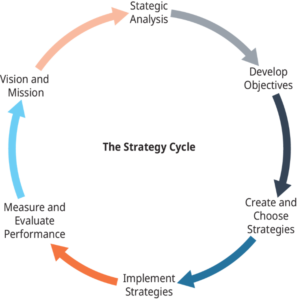
Exhibit 5.3 The Strategy Cycle (Attribution: Copyright Rice University, OpenStax, under CC-BY 4.0 license)
Concept Check
- What activities make up the strategic management process?
5.2 Firm Vision and Mission
- What is the difference between a firm’s vision and its mission?
The first step in the process of developing a successful strategic position should be part of the founding of the firm itself. When entrepreneurs decide to start a business, they usually have a reason for starting it, a reason that answers the question “What is the point of this business?” Even if an entrepreneur initially thinks of starting a business in order to be their own boss, they must also have an idea about what their business will do. Overall, entrepreneurs start businesses for a variety of reasons. A vision statement is an expression of what a business’s founders want that business to accomplish. The vision statement is usually very broad, and it does not even have to mention a product or service. The vision statement does not describe the strategy a firm will use to follow its vision—it is simply a sentence or two that states why the business exists.
While a firm’s vision statement is a general statement about its values, a firm’s mission statement is more specific. The mission statement takes the why of a vision statement and gives a broad description of how the firm will try to make its vision a reality. A mission statement is still not exactly a strategy, but it focuses on describing the products a firm plans to offer or the target markets it plans to serve.
Exhibit 5.4 gives examples of vision and mission statements for the Walt Disney Company and for Ikea. Notice that in both cases, the vision statement is very broad and is not something a business could use as a strategy because there’s simply not enough information to exhibit out what kind of business they might be. The mission statements, on the other hand, describe the products and services each company plans to offer and the customers each company plans to serve in order to fulfill their vision.
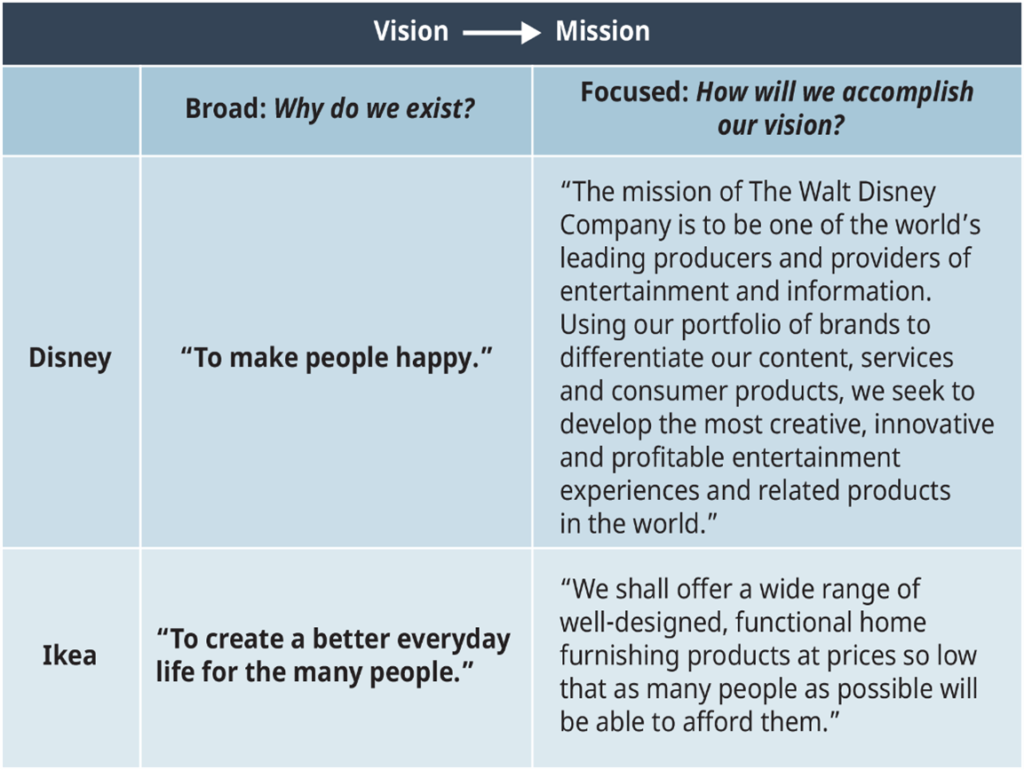
Exhibit 5.4 Vision and Mission Statements (Attribution: Copyright Rice University, OpenStax, under CC-BY 4.0 license)
An interesting thing to note about vision and mission statements is that many companies confuse them, calling a very broad statement their mission. For example, Microsoft says that its mission is “to help people around the world realize their full potential.”4 By the description above, this would be a good vision statement. However, Microsoft’s official vision statement is to “empower people through great software anytime, anyplace, and on any device.”5 Although the second statement is also quite broad, it does say how Microsoft wants to achieve the first statement, which makes it a better mission statement than vision statement.
Why are vision and mission statements important to a firm’s strategy for developing a competitive advantage? To put it simply, you can’t make a plan or strategy unless you know what you want to accomplish. Vision and mission statements together are the first building blocks in defining why a firm exists and in developing a plan to accomplish what the firm wants to accomplish.
Concept Check
- What does a mission statement explain about a firm that a vision statement does not?
- What are the similarities and differences between vision and mission?
5.3 The Role of Strategic Analysis in Formulating a Strategy
- Why is strategic analysis important to strategy formulation?
In the previous chapter, you read about the various levels of analysis that a manager carries out in order to understand their firm’s competitive environment. A strategic analysis of a firm’s external environment (the world, competitors) and internal environment (firm capabilities and resources) gives its managers a clear picture of what they have to work with and also what needs to be addressed when developing a plan for the firm’s success. Analysis comes early in the strategic process because the information a manager gets from the analysis informs the decision-making that follows. The information is so critical that entrepreneurs writing business plans (before the business even exists) do this analysis to understand if their business idea is feasible, and to understand how to position their business relative to existing competitors or potential customers in order to maximize their odds of success. Exhibit 5.5 outlines just a few of the questions that strategic analysis tools can help answer.
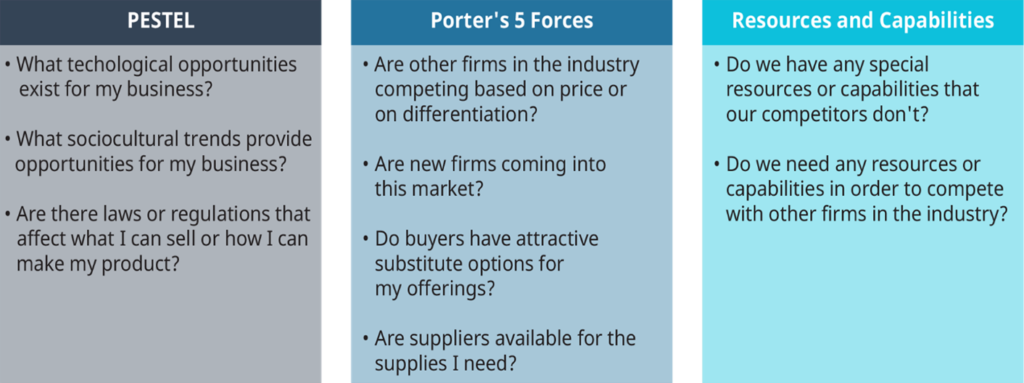
Exhibit 5.5 Some Questions That Strategic Analysis Should Answer
As an example of how the strategic tools help inform decisions, look back at the Walt Disney mission and vision in Exhibit 5.4. Imagine if you were Mr. Walt Disney today, and you wanted to start a company with a vision of making people happy in the 21st century. What products or services would you plan to offer? A PESTEL analysis would tell you that technology is an important part of entertainment and that sociocultural trends include people’s preference for on-demand entertainment, to be convenient and compatible with their busy schedules. Disney’s mission statement is broad enough about products and services to include a wide variety of offerings (they are thinking about the future too!), but if you were starting this company today, where would you start? Would you make movies for movie theaters, or develop a way to offer video entertainment online? Would you make console video games or phone apps? Who would your competition be, and what do they offer? How could you offer something better or cheaper?
Managers learn about the conditions that their business will have to operate in by doing strategic analysis, and understanding those conditions is required in order to develop the plans and actions that will lead to success.
Concept Check
- What strategic analysis tools from the previous chapter would a manager use when planning a strategy for an existing business? What tools would be most helpful for a start-up business?
5.4 Strategic Objectives and Levels of Strategy
- What are strategic objectives, levels of strategy, and a grand strategy? How are they related?
Once a strategic analysis has been completed, the next step in the strategy process is to establish strategic objectives. At this point, the manager has decided why the company exists and how it will try to fulfill its mission. Strategic analysis has provided information about customer preferences, competitors, and the firm’s resources and capabilities. Now it is time to start planning for success.
Strategic objectives
Strategic objectives are the big-picture goals for the company: they describe what the company will do to try to fulfill its mission. Strategic objectives are usually some sort of performance goal—for example, to launch a new product, increase profitability, or grow market share for the company’s product.
Exhibit 5.6 shows what might be some strategic objectives for Disney. To make people happy (Disney’s vision), Disney focuses on entertainment (its mission). Top executives then decide each year what entertainment products the company will offer. Because Disney is a large corporation (more on that shortly), it has a variety of resources available to create entertainment products to offer. For example, they may decide to release three movies this year, as well as build a new theme park and create five new shows for their television network. In reality, the strategic objectives at Disney are much more complex than this, because some of these choices involve long-term efforts (they cannot build a theme park in one year).
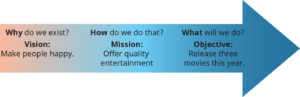
Exhibit 5.6 A Possible Strategic Path from Vision to Objective for Disney (Attribution: Copyright Rice University, OpenStax, under CC-BY 4.0 license)
Levels of Strategies
Once a firm has set its objectives, it then must turn to the question of how it will achieve them. A business-level strategy is the framework a firm uses to organize its activities, and it is developed by the firm’s top managers. Examples of business-level strategies include cost leadership and differentiation. These strategies are pursued by businesses with a single product or a range of products.
For example, imagine that you own a coffee shop. You aren’t Starbucks—you are a local shop in your neighborhood, and you run it yourself. You have employees, but you are the manager, owner, and all-around decision maker. While developing your vision and mission statements, you have already made some basic decisions about how your shop will operate. For example, you have chosen to either offer quick, inexpensive coffee (cost leadership) or a full-service coffee experience (differentiation). That decision impacts whether or not you choose premium or discount suppliers, how your shop is decorated, and how many employees you have to offer attention (service) to your customers. A business-level strategy guides a company in how they approach the activities in the value chain. Operations, for example, would focus on efficiency for a cost leader and focus on adding value for a differentiator.
When you develop strategic objectives for your shop, you will decide whether or not you want to try to attract more customers (grow), maintain your business at its current level, or shrink your business (perhaps you feel you don’t have enough time to spend with your family). If you decide that your objective is to grow, for example, you should set a specific target, say, to grow revenue by 10%. Once you set that specific objective, you can exhibit out exactly what business-level actions you will need to take to reach that target.
Even if a business is much larger than a local coffee shop, the strategic objectives pursued by these larger companies are not significantly different in concept. Large companies like Nike or Apple, which have many different business units, develop strategies at several levels. Each individual business unit (say Nike Basketball) will have a manager who decides the objectives for that unit, just as in the coffee shop example. However, the company as a whole will have a chief executive officer (the top manager for the company) who develops strategy for the entire corporation. Corporate strategy is the broadest level of strategy, and is concerned with decisions about growing, maintaining, or shrinking very large companies. At this level, business-level strategy activities, such as an advertising campaign to attract new customers for a single product line, are not going to be enough to significantly impact the company as a whole.
The corporate CEO essentially manages a group of businesses (unless the firm operates as one business unit) and develops strategies to create success for the overall group. Think of the group of businesses as an investment portfolio: investors try to have a diverse set of investments to spread risk and maximize the performance of the overall portfolio. On any given day, an investment that isn’t doing so well should be offset by one that is doing well. Corporate strategy tries to achieve the same thing, and CEOs have to weigh the pros and cons of each business unit and how it is contributing to the success of the overall corporation. For example, a company that has business units that do well in the winter (ski resorts) will try to also have business units that will perform in the summer (swimming pools) to reduce the risk of having periods of low revenue. One tool that corporate strategists use to understand how each of their businesses contributes to the corporation as a whole is the BCG Matrix, illustrated in Exhibit 5.7.
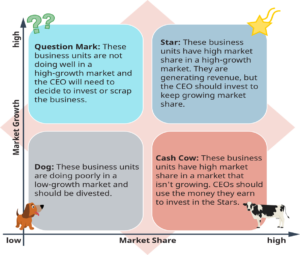
Exhibit 5.7 The BCG Matrix (Attribution: Copyright Rice University, OpenStax, under CC-BY 4.0 license)
The BCG Matrix gives managers a quick picture of which business units are doing well and which are not. The tool has recommendations for businesses in each quadrant—for example, a business in the dog quadrant should be sold or closed. Cash cows provide income to the corporation, and stars provide growth. A CEO is always trying to balance the group of business units throughout the quadrants to maximize overall corporate performance. Note that the BCG Matrix is not applicable for firm’s that operate in one business unit.
The Grand Strategy
Companies can choose a grand strategy in response to the first question they should ask themselves: does the firm want to grow, strive for stability, or take a defensive position in the marketplace? Often, the choice of a grand strategy is based on conditions in the business environment because firms generally want to grow unless something (like a recession) makes that difficult. Note that a grand strategy and a corporate strategy can overlap significantly.
A growth strategy involves developing plans to increase the size of the firm in terms of revenue, market share, or geographic reach (often a combination of these, as they can overlap significantly). Walmart is implementing a growth strategy with the acquisitions discussed in the corporate strategy section.
A stability strategy is a strategy for a company to maintain its current income, market share, or geographic reach. A firm usually works to maintain a stable position when the alternative is to lose ground in one of those categories, for example because of competition or economic factors. In today’s business environment, publicly held firms rarely aim solely to maintain the status quo, because shareholders and the stock market reward firm growth.
Firms pursue defensive strategies in the face of challenges. A company that is struggling may decide to shrink its operations to reduce costs in order to survive, for example. A company facing strong new competition may have to radically rethink its product offerings or pricing in order not to lose too much market share to the newcomer. A technological innovation may make a company’s products obsolete (or at least less attractive), forcing it to work to catch up to the new technology. Ford made a defensive decision when it recently decided to stop selling sedans in the United States because of slow sales compared to trucks and SUVs.
Operationalizing a Grand Strategy
A firm operationalizes its choice of a grand strategy differently at each level of strategy .At the business level, a growth strategy means that the manager will have to develop ways to grow the business by developing new products or expanding the customer base for existing products, either at home or abroad. Expanding a corporation can take a wider variety of forms. The CEO can develop new businesses, expand to new countries, acquire or merge with competitors, or perform previously outsourced activities. International expansion can be accomplished by exporting goods to another country or by acquiring a similar firm in another country to establish the company’s presence in that country. In all three of these cases, the grand strategy would be growth, and the strategic objectives could be expressed in terms of revenue growth, profit growth, market share growth, or even share price growth.
Concept Check
- What is the difference between strategic objectives and a strategy?
- Describe the three levels of strategy and what a manager developing strategy at each level is concerned with.
- What is a grand strategy, and how does it relate to strategic objectives and the three levels of strategy?
- What are the three grand strategies, and why would firms pursue each of them?
5.5 Is Planning Important
- Understand the importance of planning and why organizations need to plan and control.
Planning is the process by which managers establish goals and specify how these goals are to be attained. Plans have two basic components: outcome or goal statements and action statements. Outcome or goal statements represent the end state—the targets and outcomes managers hope to attain. Action statements reflect the means by which organizations move forward to attain their goals.
Planning is an intellectual activity.3 It is difficult to see managers plan, because most of this activity unfolds in the mind of those doing the planning. While planning, managers have to think about what has to be done, who is going to do it, and how and when they will do it. Planners think both retrospectively (about past events) and prospectively (about future opportunities and impending threats). Planning involves thinking about organizational strengths and weaknesses, as well as making decisions about desired states and ways to achieve them.4
Planning for organizational events, whether in the internal or external environment, should be an ongoing process—part of a manager’s daily, weekly, and monthly duties and a routine task for all members of high-involvement organizations. Plans should be continually monitored. Managers and other organizational members should check to see if their plans need to be modified to accommodate changing conditions, new information, or new situations that will affect the organization’s future. Plans need to be administered with flexibility, as organizations learn about new and changing conditions. By thinking of planning as a continuous activity, methods can be formulated for handling emerging and unforeseen opportunities and threats. Planning is one process through which organizational activity can be given meaning and direction.
Why Should Managers Plan?
Managers have several reasons for formulating plans for themselves, their employees, and various organizational units: (1) to offset uncertainty and change; (2) to focus organizational activity on a set of objectives; (3) to provide a coordinated, systematic road map for future activities; (4) to increase economic efficiency; and (5) to facilitate control by establishing a standard for later activity.
Several forces contribute to the necessity for organizational planning. First, in the internal environment, as organizations become larger and more complex, the task of managing becomes increasingly complex. Planning maps out future activities in relation to other activities in the organization. Second, as the external environment becomes increasingly complex and turbulent, the amount of uncertainty faced by a manager increases. Planning enables organizations to approach their environment systematically.
A study out of Cornell University and Indiana University found that absenteeism cost companies $40 billion per year; the absence of planning was one of the biggest problems businesses face. Firms that follow a clearly defined plan in their day-to-day operations will be more successful than those that do not. The authors state, “organizational controlled consequences that would tend to deter absenteeism.” Interestingly, this may be as simple as inspecting the organizational policies that provide the “rules” for employee absenteeism.5
Do Managers Really Plan?
Managers should plan formally, but do they? Some observers contend that managers typically are too busy to engage in a regular form of systematic planning. McGill University management professor Henry Mintzberg notes:
When managers plan, they do so implicitly in the context of daily actions, not in some abstract process reserved for two weeks in the organization’s mountain retreat. The plans of the chief executives I have studied seemed to exist only in their heads—as flexible, but often specific, intentions. . . . The job of managing does not breed reflective planners; the manager is a real-time responder to stimuli.6
Others disagree. After reviewing a number of studies focused on the degree to which planning and other managerial activities are inherent parts of managing, management professors J. Carroll and J. Gillen state that “the classical management functions of Fayol, Urwick, and others are not folklore as claimed by some contemporary management writers but represent valid abstractions of what managers actually do and what managers should do.”7 Barbara Allen, president of Sunbelt Research Associates, notes that she did a considerable amount of planning before launching her new business. Now that she is operating successfully, she reviews and updates her plans periodically.8
Managers often are very busy people. Some act without a systematic plan of action; however, many managers do plan systematically.9 For example, many managers develop systematic plans for how their organization will react to a crisis. United Airlines, for example, created a crisis planning group. The group developed United’s crisis contingency plan book, which specifies what the airline’s crisis management team should do in the event of a crisis. Keri Calagna, principal, Deloitte Risk and Financial Advisory, Deloitte & Touche LLP, comments that up to 20.7% of a firm’s value resides in reputation but that CEOs and 77% of board of directors members identified reputation risk as the area about which they felt most vulnerable and that only 39% had a plan to address it.10
The question about whether managers really plan and the observation that many times they are simply too busy to retreat to the mountaintop and reflect on where the organization should be going and how it should get there miss the point: there are different types of planning.
Concept Check
- What is the process where managers establish goals and outline how these goals will be met called?
- How do the internal and external environments of the organization and its strengths and weaknesses impact the planning process?
- Why should managers plan?
5.6 The Planning Process
- Outline the planning and controlling processes.
Planning is a process. Ideally it is future oriented, comprehensive, systematic, integrated, and negotiated.11 It involves an extensive search for alternatives and analyzes relevant information, is systematic in nature, and is commonly participative.12 The planning model described in this section breaks the managerial function of planning into several steps, as shown in Exhibit 5.8. Following this step-by-step procedure helps ensure that organizational planning meets these requirements.
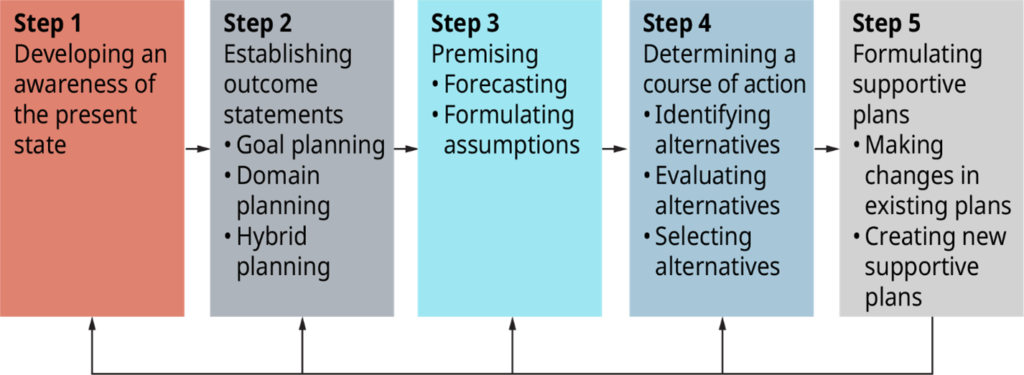
Exhibit 5.8 The Planning Process Source: Adapted from H. Koontz and C. O’Donnell, 1972. Principles of management: An analysis of managerial functions. New York: McGraw-Hill, 113.
Step 1: Developing an Awareness of the Present State
According to management scholars Harold Koontz and Cyril O’Donnell, the first step in the planning process is awareness.13 It is at this step that managers build the foundation on which they will develop their plans. This foundation specifies an organization’s current status, pinpoints its commitments, recognizes its strengths and weaknesses, and sets forth a vision of the future. Because the past is instrumental in determining where an organization expects to go in the future, managers at this point must understand their organization and its history. It has been said—“The further you look back, the further you can see ahead.”14
Step 2: Establishing Outcome Statements
The second step in the planning process consists of deciding “where the organization is headed, or is going to end up.” Ideally, this involves establishing goals. Just as your goal in this course might be to get a certain grade, managers at various levels in an organization’s hierarchy set goals. For example, plans established by a university’s marketing department curriculum committee must fit with and support the plans of the department, which contribute to the goals of the business school, whose plans must, in turn, support the goals of the university. Managers therefore develop an elaborate network of organizational plans, such as that shown in Exhibit 5.9, to achieve the overall goals of their organization.

Exhibit 5.9 Network of Organization Plans (Attribution: Copyright Rice University, OpenStax, under CC-BY 4.0 license)
Goal vs. Domain Planning
Outcome statements can be constructed around specific goals or framed in terms of moving in a particular direction toward a viable set of outcomes. In goal planning, people set specific goals and then create action statements.15 For example, freshman Kristin Rude decides that she wants a bachelor of science degree in biochemistry (the goal). She then constructs a four-year academic plan that will help her achieve this goal. Kristin is engaging in goal planning. She first identifies a goal and then develops a course of action to realize her goal.
Another approach to planning is domain/directional planning, in which managers develop a course of action that moves an organization toward one identified domain (and therefore away from other domains).16 Within the chosen domain may lie a number of acceptable and specific goals. For example, high-school senior Neil Marquardt decides that he wants to major in a business-related discipline in college. During the next four years, he will select a variety of courses from the business school curriculum yet never select a major. After selecting courses based on availability and interest, he earns a sufficient number of credits within this chosen domain that enables him to graduate with a major in marketing. Neil never engaged in goal planning, but in the end he will realize one of many acceptable goals within an accepted domain.
The development of the Post-it® product by the 3M Corporation demonstrates how domain planning works. In the research laboratories at 3M, efforts were being made to develop new forms and strengths of cohesive substances. One result was cohesive material with no known value because of its extremely low cohesive level. A 3M division specialist, Arthur L. Fry, frustrated by page markers falling from his hymn book in church, realized that this material, recently developed by Spencer F. Silver, would stick to paper for long periods and could be removed without destroying the paper. Fry experimented with the material as page markers and note pads—out of this came the highly popular and extremely profitable 3M product Scotch Post-it®. Geoff Nicholson, the driving force behind the Post-it® product, comments that rather than get bogged down in the planning process, innovations must be fast-tracked and decisions made whether to continue or move on early during the product development process.17

Exhibit 5.10 Post It Notes Post-it® notes, a 3M product, are often used to create and edit shared documents, such as a company strategic plan. How might technology that allows multiple people to share and edit documents such as Word or PowerPoint files affect the sales of Post-it® products? (Credit: Kevin Wen/ flickr/ Attribution 2.0 Generic (CC BY 2.0))
Situations in which managers are likely to engage in domain planning include (1) when there is a recognized need for flexibility, (2) when people cannot agree on goals, (3) when an organization’s external environment is unstable and highly uncertain, and (4) when an organization is starting up or is in a transitional period. In addition, domain planning is likely to prevail at upper levels in an organization, where managers are responsible for dealing with the external environment and when task uncertainty is high. Goal planning (formulating goals compatible with the chosen domain) is likely to prevail in the technical core, where there is less uncertainty.
Hybrid Planning
Occasionally, coupling of domain and goal planning occurs, creating a third approach, called hybrid planning. In this approach, managers begin with the more general domain planning and commit to moving in a particular direction. As time passes, learning occurs, uncertainty is reduced, preferences sharpen, and managers are able to make the transition to goal planning as they identify increasingly specific targets in the selected domain. Movement from domain planning to goal planning occurs as knowledge accumulates, preferences for a particular goal emerge, and action statements are created.
Consequences of Goal, Domain, and Hybrid Planning
Setting goals not only affects performance directly, but also encourages managers to plan more extensively. That is, once goals are set, people are more likely to think systematically about how they should proceed to realize the goals.18 When people have vague goals, as in domain planning, they find it difficult to draw up detailed action plans and are therefore less likely to perform effectively. When studying the topic of motivation, you will learn about goal theory. Research suggests that goal planning results in higher levels of performance than does domain planning alone.19
Step 3: Premising
In this step of the planning process, managers establish the premises, or assumptions, on which they will build their action statements. The quality and success of any plan depends on the quality of its underlying assumptions. Throughout the planning process, assumptions about future events must be brought to the surface, monitored, and updated.20
Managers collect information by scanning their organization’s internal and external environments. They use this information to make assumptions about the likelihood of future events. As Kristin considers her four-year pursuit of her biochemistry major, she anticipates that in addition to her savings and funds supplied by her parents, she will need a full-time summer job for two summers in order to cover the cost of her undergraduate education. Thus, she includes finding full-time summer employment between her senior year of high school and her freshman year and between her freshman and sophomore years of college as part of her plan. The other two summers she will devote to an internship and finding postgraduate employment—much to mom and dad’s delight! Effective planning skills can be used throughout your life. The plan you develop to pay for and complete your education is an especially important one.
Step 4: Determining a Course of Action (Action Statements)
In this stage of the planning process, managers decide how to move from their current position toward their goal (or toward their domain). They develop an action statement that details what needs to be done, when, how, and by whom. The course of action determines how an organization will get from its current position to its desired future position. Choosing a course of action involves determining alternatives by drawing on research, experimentation, and experience; evaluating alternatives in light of how well each would help the organization reach its goals or approach its desired domain; and selecting a course of action after identifying and carefully considering the merits of each alternative.
Step 5: Formulating Supportive Plans
The planning process seldom stops with the adoption of a general plan. Managers often need to develop one or more supportive or derivative plans to bolster and explain their basic plan. Suppose an organization decides to switch from a 5-day, 40-hour workweek (5/40) to a 4-day, 40-hour workweek (4/40) in an attempt to reduce employee turnover. This major plan requires the creation of a number of supportive plans. Managers might need to develop personnel policies dealing with payment of daily overtime. New administrative plans will be needed for scheduling meetings, handling phone calls, and dealing with customers and suppliers.
Planning, Implementation, and Controlling
After managers have moved through the five steps of the planning process and have drawn up and implemented specific plans, they must monitor and maintain their plans. Through the controlling function (to be discussed in greater detail later in this chapter), managers observe ongoing human behavior and organizational activity, compare it to the outcome and action statements formulated during the planning process, and take corrective action if they observe unexpected and unwanted deviations. Thus, planning and controlling activities are closely interrelated (planning ➨ controlling ➨ planning . . .). Planning feeds controlling by establishing the standards against which behavior will be evaluated during the controlling process. Monitoring organizational behavior (the control activity) provides managers with input that helps them prepare for the upcoming planning period—it adds meaning to the awareness step of the planning process.
Influenced by total quality management (TQM) and the importance of achieving continuous improvement in the processes used, as well as the goods and services produced, organizations such as IBM-Rochester have linked their planning and controlling activities by adopting the Deming cycle (also known as the Shewhart cycle).
It has been noted on numerous occasions that many organizations that do plan fail to recognize the importance of continuous learning. Their plans are either placed on the shelf and collect dust or are created, implemented, and adhered to without a systematic review and modification process. Frequently, plans are implemented without first measuring where the organization currently stands so that future comparisons and evaluations of the plan’s effectiveness cannot be determined.
Concept Check
- What are the five steps in the planning process?
- What is the difference between goal, domain, and hybrid planning?
- How are planning, implementation, and controlling related?
5.7 Planning Firm Actions to Implement Strategies
How and why do managers plan? Why are goals important in the planning process?
When managers create strategies, they are making plans for how their firm will compete in the marketplace and what actions the firm will have to undertake to compete. A plan is a decision to carry out a particular action in order to achieve a specific goal. A plan includes decisions about when and how actions should be accomplished and what resources will be required to complete the actions. Because planning is one of the basic functions of management, a good manager should have good goal-setting skills, technical knowledge about the tasks necessary to reach goals, time-management skills, and the organizational skills required to arrange company resources to be available to complete the planned tasks. Planning is a combination of deciding what needs to be done, figuring out how to do it, assigning roles to people and providing them the resources to complete their tasks, and overseeing the work to make sure it gets done correctly and in a timely manner.
Goal Setting
To examine the planning process, we need to start by understanding what the planning is for. A goal is something that you are trying to accomplish, and any firm will have many items on its list of things to accomplish. Consider the situation of a Walmart store in a college town. When it’s time for students to arrive back to school in the fall, the store needs to be ready with all the products students need when they move in. The Walmart store manager will plan months in advance and use information learned from the previous year’s sales to decide what products to order and how many, and when to have extra staff in the store to efficiently check out increased numbers of shoppers. Note that since Walmart is a global firm, goals will likely be prescribed from a higher level and the store manager’s responsibility would be to functional strategy response.
The manager’s plans will take into account the lead time for ordering products to make sure that mini-refrigerators and twin XL sheets arrive and can be stocked in the store in time for the back-to-school rush. Preparing for the back-to-school season may involve reducing prices on other items to get them out of the way to make room for all those small refrigerators, and hiring and training additional employees so that there will be enough associates to help students and their parents. The manager’s ultimate goal is to have a successful back-to-school sales season, but achieving that goal will involve completing tasks such as making product-selection decisions, meeting ordering deadlines, and setting intermediate goals for hiring and training additional employees.
Setting Good Goals: The SMART Framework
Good goals have a few common characteristics, and Exhibit 5.11 presents a framework for creating good goals.
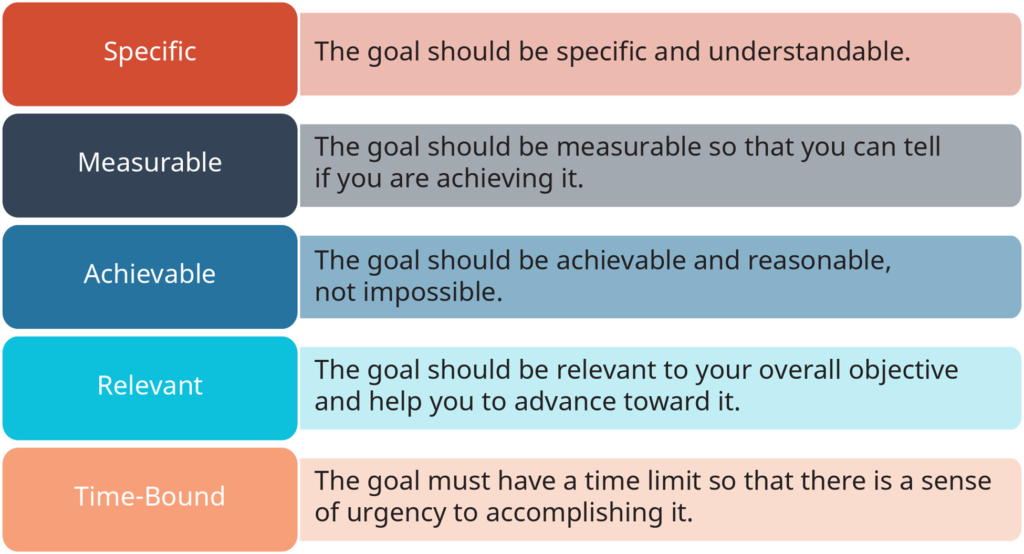
Exhibit 5.11 SMART Goals (Attribution: Copyright Rice University, OpenStax, under CC-BY 4.0 license)
The SMART framework can be applied to business or personal goals. A good goal should be Specific, Measurable, Achievable, Relevant, and Time-bound.
Say you want to do well in this class. You need to turn that into a specific goal, because “doing well” is a little vague. Make the goal more specific by stating that your goal is to get an A in this course. Is this goal measurable? Well, yes: grades are good examples of performance measures. Is your goal achievable? That’s something you have to think about yourself: Do you usually get good grades? Are you able to put in the time to study the course material? Is the goal relevant to the achievement of a larger objective such as graduating with a good overall grade point average? If so, then getting an A in this class would contribute to that larger goal. Will you have time to accomplish your goal? Class-grade goals are inherently time-bound because the class ends on a certain date. So it’s possible that getting an A in this class is an overall SMART goal. To achieve it, however, you have to set some shorter term goals—for example, you should set a SMART goal for getting an A on the next exam.
The Planning Cycle
Exhibit 5.12 illustrates the planning cycle. The first step in planning is to set a goal to be accomplished. Making sure that the goal checks off all of the SMART criteria will help make the planning process easier and more likely to be successful, so be sure to spend some time developing a good goal.
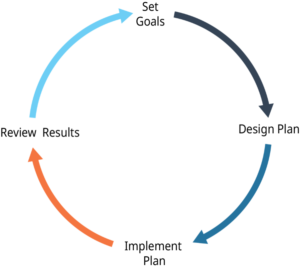
Exhibit 5.12 The Planning Cycle (Attribution: Copyright Rice University, OpenStax, under CC-BY 4.0 license)
Once you’ve figured out your goal, the next step is to design the plan. “Designing the plan” involves several distinct activities, so let’s break it down into what needs to happen. Think of planning as a problem-solving exercise. A plan is a set of actions developed to accomplish a goal, and planning is essentially figuring out what those actions should be. The goal is the end point, and the plan answers the question “How do we get there?”
When designing a plan, a manager may think of many ways to achieve a goal. They or she can have a group of employees brainstorm to come up with ideas. Not all of the potential ideas are likely to be feasible, however. Part of the manager’s task in designing a plan is to coordinate various ideas with a firm’s resources and capabilities and its time constraints (see Exhibit 5.13). When does the goal need to be accomplished? What other resources does the firm need to complete the project?
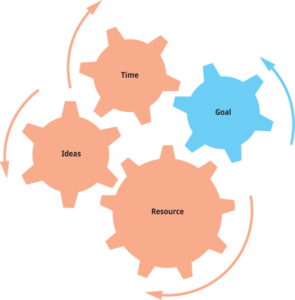
Exhibit 5.13 Planning Requires Coordination (Attribution: Copyright Rice University, OpenStax, under CC-BY 4.0 license)
Designing the plan becomes a puzzle of figuring out what is the best way to reach a goal with the resources the firm has or can reasonably get in the time available. There is no prescription for this, and the best way to learn how to plan is to practice. Fortunately, you probably have a pretty good amount of practice already, because you’ve been planning in one form or another for a long time. You have planned study time, team practices, club events, and even meals. Strategic planning uses the same skills in a new context. Planning a product launch may sound complicated, but so is planning a wedding. The scale and scope of the things a manager must coordinate in order to reach company goals may be larger than what you are used to, but the specific skills are likely not new at all.
For example, let’s take a look at the challenge Tesla is currently facing.
Tesla has developed a mass-market car and has a line of about half a million customers waiting to buy one. Until now, Tesla has been more of a boutique car maker, manufacturing small numbers of cars that they are able to sell at high prices. The Model 3, however, has been specifically conceived as an affordable car that almost anyone can buy. The brand and reputation Tesla has built with its premium cars has generated a lot of enthusiasm and demand for this new model. So Elon Musk, CEO of Tesla, is planning to make cars in larger numbers and more quickly than ever before.
What’s Tesla’s goal? Manufacture cars at a rate of 500,000 per year in order to meet demand. Is this a SMART goal? Analysts around the world are arguing over this (is it achievable?), but it’s the goal that Tesla is focusing on, so Musk has to design a plan to reach that goal. What resources does Tesla need in order to reach this level of production? They developed a car that is easy to manufacture, because they knew that they would want to build it in large numbers. Still, they need manufacturing facilities, parts, and production employees. To get these resources, they need money. Elon Musk is a spectacular fundraiser, but they need billions of dollars to develop manufacturing capabilities on this scale. So while Tesla builds the world’s largest factory in Nevada, called the Gigafactory, Musk continues to raise funds.
Components (specifically the batteries) are also an issue for the Model 3, and Musk has built his giant factory in part to manufacture the hundreds of thousands of batteries needed to power the Model 3. Tesla’s planning involves many interrelated activities, and figuring out what the activities are, what resources Tesla needs to perform the activities, and how to obtain resources that they need but don’t have yet are the challenges Elon Musk is tackling. Tesla is a fascinating company that is multifaceted. There have been serious questions raised about their ability to produce enough cars and an examination of more recent commentary is encouraged.
Implementing Plans for Different Levels of Firm Activity and Time Horizons
Developing plans happens simultaneously at multiple levels in any company. Plans, as in our earlier grade example, often require different steps in order to achieve a large-scale objective. If a firm decides on growth as a grand strategy, actions at every level of firm activity should contribute to firm growth, and managers at all of those levels should develop plans so that their part of the firm is working to implement the growth strategy. A grand strategy cascades throughout the company, becoming more and more specific, until front-line employees are working on specific tasks that support the grand strategy.
Time is an important consideration when top managers develop company goals and the plans to achieve them. In general, firms have two time spans that they plan for: short term and long term. A short-term strategic plan is one that can be accomplished in a year or sooner. A long-term strategic plan is developed when an objective cannot be accomplished in less than a year. Companies generally have both scales of plans in place at any given time: short-term plans might involve quarterly sales goals, for example, but a firm might have a longer-term goal of establishing operations in another country or building a new facility. Tesla’s Gigafactory and Apple’s new headquarters at Apple Park in Cupertino, California, are both multiyear, multibillion dollar projects, and so would be good examples of long-term plans. In Tesla’s case, the Gigafactory was initially planned many years ago when the company knew that it wanted to mass-produce cars at the scale required for the Model 3.7
Scale Levels of Planning
Another dimension that impacts strategic planning is scale. We have already looked at some large-scale planning concepts, such as business-level and grand strategies. However, the day-to-day planning that managers do to take steps toward those bigger objectives is key to achieving success. Exhibit 5.14 shows the typical levels of planning going on in a company at any given time.
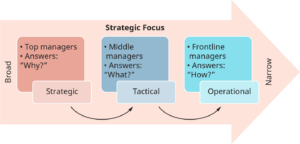
Exhibit 5.14 Levels of Strategic Planning (Attribution: Copyright Rice University, OpenStax, under CC-BY 4.0 license)
Notice that, if you compare Exhibit 5.14 to Exhibit 5.6, the “what” and “how” are switched. The switch is a scale switch. Vision and mission are both conceived at the broadest scale, and so even the “how” of the mission is a large-scale idea. In contrast, when managers are planning, the “how” of operational planning lays out precise actions and steps to follow to achieve a specific objective.
Let’s look at the levels one by one. Strategic planning is what we’ve been discussing so far. It’s the high-level planning performed by company executives in order to set the overall direction of the company. Grand strategies are part of strategic planning, as are business-level strategies such as cost leadership. Strategic planning connects the company’s actions back to its vision and mission statements (the “why does this company exist” question).
Tactical planning is mid-level planning that consists of broad ideas of what the company should do to pursue its mission. This is the sort of planning done by division managers. For example, Walmart division managers carry out the company’s growth and cost-leadership strategies by finding ways for the company to grow and continue to be able to offer low prices. They may decide where to locate distribution centers to maximize store-stocking efficiency, which manufacturers of goods they can buy inventory from at low prices, and where to build new stores to attract more customers.
Operational planning lays out the front-line activities that each employee in the company will do to advance the tactical plans. A McDonald’s restaurant manager develops operational plans, but you might recognize them more as employee schedules or promotional plans. Operational plans are the daily activities required for the company to function, including ordering inventory or supplies, scheduling workers and defining their work tasks, and developing sales goals and promotions to help achieve those goals. At McDonald’s, as at other companies that pursue a cost-leadership strategy, scheduling enough employees to work in the restaurant at specific times to keep the store functioning smoothly without scheduling more than you need (and incurring excess labor costs) is a critical task for the manager, and doing that task successfully is how the manager contributes to the company’s larger cost-leadership strategy.
Implementing Planned Strategies
Implementation of planned strategies refers to the execution of a strategy by assigning tasks for people to carry out to accomplish the company’s strategic goals. Although a manager may talk about “implementing a differentiation strategy,” the real implementation of a strategy happens at the bottom of not just the strategy hierarchy, but the organizational hierarchy, in the actions of operational employees who carry out planned tasks that add value to the company’s product. Such tasks include research and development to add unique features, monitoring manufacturing to ensure company products meet high quality standards, and marketing the product to add brand value in the eyes of consumers.
Concept Check
- What are the three levels of planning, and what kinds of plans do managers develop at each level?
- Why is strategic implementation most commonly carried out at the operational level?
5.8 Types of Plans
Identify different types of plans and control systems employed by organizations.
From an activity perspective, organizations are relatively complex systems, as they are involved in numerous activities. Many of these activities require management’s attention from both a planning and controlling perspective. Managers therefore create different types of plans to guide operations and to monitor and control organizational activities. In this section, we introduce several commonly used plans. The major categories are hierarchical, frequency-of-use (repetitiveness), time-frame, organizational scope, and contingency. Table 5.1 provides a closer look at many types of plans that fall in each of these categories.
Hierarchical Plans
Organizations can be viewed as a three-layer cake, with its three levels of organizational needs. Each of the three levels—institutional, administrative, and technical core—is associated with a particular type of plan. As revealed in Table 5.1, the three types of hierarchical plans are strategic, tactical, and operating (technical core). The three hierarchical plans are interdependent, as they support the fulfillment of the three organizational needs. In the organization’s hierarchy, the technical core plans day-to-day operations.
|
Strategic plans (institutional)—define the organization’s long-term vision; articulate the organization’s mission and value statements; define what business the organization is in or hopes to be in; articulate how the organization will integrate itself into its general and task environments. Tactical plans—specify the allocation of organizational resources to internal units of the organization; address the integration of the institutional level of the organization (for example, vision formulation) with the technical core (vision implementation); address the integration of the diverse units of the organization. Operating plans (technical core)—cover the day-to-day operations of the organization. |
|
Frequency-of-Use Plans |
|
Standing Plans |
|
Policies—general statements of understanding or intent; guide decision-making, permitting the exercise of some discretion; guide behavior (for example, no employee shall accept favors and/or entertainment from an outside organization that are substantial enough in value to cause undue influence over one’s decisions on behalf of the organization). Rules—guides to action that do not permit discretion in interpretation; specify what is permissible and what is not permissible. Procedures—like rules, they guide action; specify a series of steps that must be taken in the performance of a particular task. |
|
Single-Use Plans |
|
Programs—a complex set of policies, rules, and procedures necessary to carry out a course of action. Projects—specific action plans often created to complete various aspects of a program. Budgets—plans expressed in numerical terms. |
|
Time-Frame Plans |
|
Short-, medium-, and long-range plans—differ in the distance into the future projected: Short-range—several hours to a year Medium-range—one to five years Long-range—more than five years |
|
Contingency Plans |
|
Plans created to deal with events that might come to confront the organization (e.g., natural disasters, terrorist threats); alternative courses of action that are to be implemented if events disrupt a planned course of action. |
Table 5.1 (Attribution: Copyright Rice University, OpenStax, under CC-BY 4.0 license)
Strategic Plans
Strategic management is that part of the management process concerned with the overall integration of an organization’s internal divisions while simultaneously integrating the organization with its external environment. Strategic management formulates and implements tactics that try to match an organization as closely as possible to its task environment for the purpose of meeting its objectives.
Strategic plans address the organization’s institutional-level needs. Strategic plans outline a long-term vision for the organization. They specify the organization’s reason for being, its strategic objectives, and its operational strategies—the action statements that specify how the organization’s strategic goals are to be achieved.
Part of strategic planning involves creating the organization’s mission, a statement that specifies an organization’s reason for being and answers the question “What business(es) should we undertake?” The mission and the strategic plan are major guiding documents for activities that the organization pursues. Strategic plans have several defining characteristics: They are long-term and position an organization within its task environment; they are pervasive and cover many organizational activities; they integrate, guide, and control activities for the immediate and the long term; and they establish boundaries for managerial decision-making.
Operating plans provide direction and action statements for activities in the organization’s technical core. Administrative plans work to integrate institutional-level plans with the operating plans and tie together all of the plans created for the organization’s technical core.
Frequency-of-Use Plans
Another category of plans is frequency-of-use plans. Some plans are used repeatedly; others are used for a single purpose. Standing plans, such as rules, policies, and procedures, are designed to cover issues that managers face repeatedly. For example, managers may be concerned about tardiness, a problem that may occur often in the entire work force. These managers might decide to develop a standing policy to be implemented automatically each time an employee is late for work. The procedure invoked under such a standing plan is called a standard operating procedure (SOP).
Single-use plans are developed for unique situations or problems and are usually replaced after one use. Managers generally use three types of single-use plans: programs, projects, and budgets. See Table 5.1 for a brief description of standing and single-use plans.
Time-Frame Plans
The organization’s need to address the future is captured by its time-frame plans. This need to address the future through planning is reflected in short-, medium-, and long-range plans. Given the uniqueness of industries and the different time orientations of societies—study Hofstede’s differentiation of cultures around the world in terms of their orientation toward the future—the times captured by short, medium, and long range vary tremendously across organizations of the world. Konosuke Matsushita’s 250-year plan, which he developed for the company that bears his name, is not exactly typical of the long-range plans of U.S. companies!
Short-, medium-, and long-range plans differ in more ways than the time they cover. Typically, the further a plan projects into the future, the more uncertainty planners encounter. As a consequence, long-range plans are usually less specific than shorter-range plans. Also, long-range plans are usually less formal, less detailed, and more flexible than short-range plans in order to accommodate such uncertainty. Long-range plans also tend to be more directional in nature.
Contingency Plans
Organizations often engage in contingency planning (also referred to as scenario or “what if” planning). You will recall that the planning process is based on certain premises about what is likely to happen in an organization’s environment. Contingency plans are created to deal with what might happen if these assumptions turn out to be wrong. Contingency planning is thus the development of alternative courses of action to be implemented if events disrupt a planned course of action. A contingency plan allows management to act immediately if an unplanned occurrence, such as a strike, boycott, natural disaster, or major economic shift, renders existing plans inoperable or inappropriate. For example, airlines develop contingency plans to deal with terrorism and air tragedies. Most contingency plans are never implemented, but when needed, they are of crucial importance.
Concept Check
- Define and describe the different types of plans defined in Table 17.1 and how organizations use them.
5.9 Management by Objectives: A Planning and Control Technique
- Describe management by objectives as a philosophy and as a management tool/technique; describe its effects.
When people are personally committed to their organization’s plans, those plans are more likely to be accomplished. This is the philosophy underlying management by objectives.
Management by objectives (MBO) is a philosophy of management, a planning and controlling technique, and an employee-involvement program.60 As a management philosophy, MBO stems from the human resource model and Theory Y’s assumption that employees are capable of self-direction and self- control. MBO also is anchored in Maslow’s need theory. The reasoning is that employee involvement in the planning and control processes provides opportunities for the employee to immerse the self in work-related activities, to experience work as more meaningful, and to satisfy higher-order needs (such as self-esteem), which leads to increased motivation and job performance (see Exhibit 5.15). It is hypothesized that, through involvement, employee commitment to a planned course of action will be enhanced and job satisfaction will be increased.

Exhibit 5.15 MBO and Its Effect on Employees (Attribution: Copyright Rice University, OpenStax, under CC-BY 4.0 license)
Although there are many variations in the practice of MBO, it is basically a process by which an organization’s goals, plans, and control systems are defined through collaboration between managers and their employees. Together they identify common goals, define the results expected from each individual, and use these measurements to guide the operation of their unit and to assess individual contributions.61 In this process, the knowledge and skills of many organizational members are used. Rather than managers telling workers “These are your goals”—the approach of classical management philosophy—managers ask workers to join them in deciding what their goals should be.
After an acceptable set of goals has been established for each employee through a give-and-take, collaborative process, employees play a major role in developing an action plan for achieving these goals. In the final stage in the MBO process, employees develop control processes, monitor their own performance, and recommend corrections if unplanned deviations occur. At this stage, the entire process begins again. Exhibit 5.16 depicts the major stages of the MBO process.
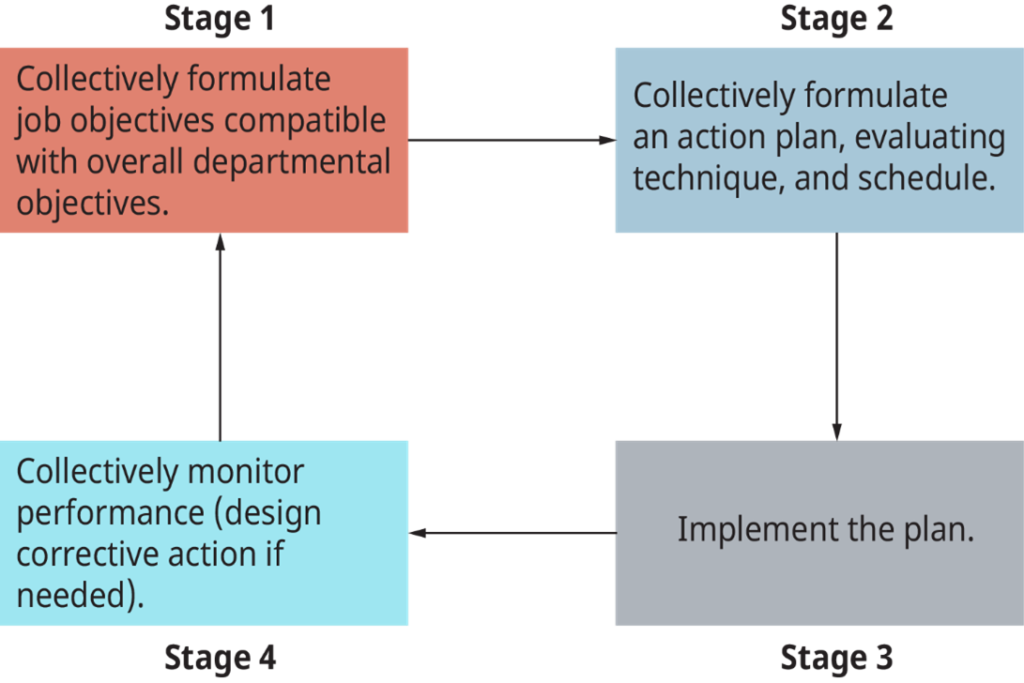
Exhibit 5.16 The Management by Objective (MBO) Process (Attribution: Copyright Rice University, OpenStax, under CC-BY 4.0 license)
The Theory of MBO
MBO has the potential to enhance organizational effectiveness. The following four major components of the MBO process are believed to contribute to its effectiveness: (1) setting specific goals; (2) setting realistic and acceptable goals; (3) joint participation in goal setting, planning, and controlling; and (4) feedback.62 First, as we saw earlier, employees working with goals outperform employees working without goals. Second, it is assumed that participation contributes to the setting of realistic goals for which there is likely to be goal acceptance and commitment. Setting realistic and acceptable goals is an important precondition for successful outcomes, especially if the goals are difficult and challenging in nature. Finally, feedback plays an important role. It is only through feedback that employees learn whether they should sustain or redirect their efforts in order to reach their goal, and it is only through feedback that they learn whether or not they are investing sufficient effort.
Thus, from a theoretical perspective, there are several reasons why MBO should produce a positive impact on employee performance, motivation, commitment, and job satisfaction. In the next section, we briefly look at what the research tells us about the effectiveness of MBO programs.
The Evidence
In both the public and private sectors, MBO is a widely employed management tool. A recent review of the research on MBO provides us with a clear and consistent view of the effects of these programs. In the 70 cases studied by Robert Rodgers and John Hunter, 68 showed increased productivity gains, and only 2 showed losses.63 In addition, the increases in performance were significant. Rodgers and Hunter report that the mean increase exceeded 40 percent.
While the results are generally positive in nature, differences in performance effects appear to be associated with the level of top management commitment. In those cases where top management is emotionally, intellectually (that is, top management espouses the value and importance of MBO), and behaviorally (top management actually uses MBO themselves) committed, the performance effects tend to be the strongest. The weakest MBO effects appear when top management does very little to “talk the value/importance of MBO” and they don’t use the system themselves, even as they implement it for others.64 This evidence tells us that “the processes” used to implement MBO may render a potentially effective program ineffective. Thus, not only should managers pay attention to the strategies used to facilitate planning and controlling (like MBO), they should also be concerned with how they go about implementing the plans. MBO requires top management commitment, and it should be initiated from the top down.65
Research shows that an MBO program can play a meaningful role in achieving commitment to a course of action and improving performance. In fact, research clearly documents instances where MBO programs have increased organizational effectiveness. Still, there have been failures. After reviewing 185 studies of MBO programs, one researcher concluded that they are effective under some circumstances but not all.66 For example, MBO tends to be more effective in the short term (less than two years), in the private sector, and in organizations removed from direct contact with customers.
To be truly effective over the long haul, MBO programs probably need to be coupled with some type of gainsharing program (that is, programs whereby organizations share some of the financial gains accrued from the ideas, productivity improvements, and cost savings that stem from employee participation). Based on his extensive observation of involvement-oriented organizations, Edward E. Lawler III notes that information, knowledge, power, and rewards are four key components of an effective and sustained high involvement.67 Typically, MBO systems don’t provide mechanisms through which employees share in the economic gains that may accrue to the organization as a result of their expanded role and responsibility. In light of the conditions that influence the effectiveness of MBO programs, management is challenged to provide an appropriate context for the design and maintenance of an effective MBO system.
Concept Check
- What is management by objectives?
Key Terms
BCG matrix
a tool used to evaluate the various business units in a corporation.
business-level strategy
ways that single-product firms organize their activities to succeed against rivals; at this level, include cost leadership and differentiation.
contingency plans
Plans that deal with alternative courses of action.
corporate strategy
the broadest level of strategy, concerned with decisions about growing, maintaining, or shrinking very large companies.
defensive strategy
a grand strategy pursued by companies facing challenges.
goal
something that a firm is trying to accomplish; can also be called an objective.
growth strategy
a grand strategy to increase the size of the firm in terms of revenue, market share, geographic reach, or a combination of these elements.
implementation
the execution of a strategy by planning and assigning actions to employees to carry out in order to accomplish the company’s strategic objectives.
long-term strategic plan
company actions to achieve an objective that will take a year or longer to accomplish.
management by objectives (MBO)
A philosophy of management, a planning and controlling technique, and an employee involvement program.
mission statement
a general description of how the firm will try to accomplish the firm’s vision.
operational planning
first-line strategic planning consisting of specific daily and short-term actions that employees will perform to make the company function.
performance measurement
the evaluation of firm activities to determine the success of that activity in helping the firm reach its strategic objectives.
plan
a decision to carry out a particular action in order to achieve a specific goal, including decisions about when and how the action should be accomplished and what resources will be required to carry out the action.
short-term strategic plan
company actions to achieve an objective in a time frame of a year or less.
single-use plans
Plans developed for unique situations or problems and one-time use.
SMART framework
an acronym for the characteristics of good goals: specific, measurable, achievable, relevant, and time-bound.
standing plans
Rules, policies, and procedures about how to deal with issues that managers face repeatedly.
strategic plans
Hierarchical plans that address an organization’s institutional-level needs and attempt to position it advantageously within its task environment.
stability strategy
a grand strategy for a company that wants maintain its current income, market share, or geographic reach.
strategic analysis
the systematic examination of a firm’s internal and external situation that informs managerial decision-making.
strategic management process
the set of activities that firm managers undertake in order to try to put their firms in the best possible position to compete successfully in the marketplace.
strategic objectives
the big-picture goals for the company: what the company will do to try to fulfill its mission.
strategic planning
connects the company’s actions back to its vision and mission statements.
tactical planning
mid-level strategic planning consisting of broad ideas of what a company should do to pursue its mission.
vision statement
a broad expression of what a business’s founders want that business to accomplish.
Summary of Learning Outcomes
5.1 Strategic Management
What is the strategic management process?
The strategic management process is the set of activities that firm managers undertake to put their firms in the best possible position to compete successfully in the marketplace. Strategic management is made up of several distinct activities: developing the firm’s vision and mission; strategic analysis; developing objectives; creating, choosing, and implementing strategies; and measuring and evaluating performance.
5.2 Firm Vision and Mission
What is the difference between a firm’s vision and its mission?
A firm’s vision is a broad statement expressing the reason for the firm’s existence and what it hopes to accomplish. The mission statement explains (still broadly) how the firm intends to fulfill its vision—for example, by stating what products or services the firm will offer or what customers it wants to serve.
5.3 The Role of Strategic Analysis in Formulating a Strategy
Why is strategic analysis important to strategy formulation?
Strategic analysis produces information that managers need in order to develop appropriate strategies for their firms. A good strategy should use a firm’s resources and capabilities to stake out a position in the marketplace that sets it apart from competitors and enables it to successfully compete in the external environment.
5.4 Strategic Objectives and Levels of Strategy
What are strategic objectives, levels of strategy, and a grand strategy? How are they related?
Strategic objectives are the big-picture goals for the company: what the company will do to try to fulfill its mission. These goals are broad and are developed based on top management’s choice of a generic competitive strategy and grand strategy for the firm. For example, cost-leadership and growth competitive and grand strategies will require managers to develop objectives for growing the firm in a low-cost way.
Business-level strategy is concerned with positioning a single company or business unit that focuses on a single product or product line. The primary business-level strategies are cost leadership and differentiation, as well as focus, which is combined with one of the other two strategies (focus-cost leadership, focus-differentiation).
Corporate-level strategy is concerned with the management and direction of multi-business corporations. These large firms make decisions about what businesses and industries to operate in so they can improve their overall performance and reduce the risk they would face if all of their operations were concentrated in a single business or industry. Corporate CEOs use the BCG Matrix to evaluate their portfolio of businesses and use corporate actions like acquisitions to make significant changes to their companies.
International strategy can be combined with either of the previous two strategies to incorporate international operations into a business or corporation. International strategy answers questions of what country or countries to operate in and how to be successful in foreign operations.
Grand strategies outline an approach to firm growth. The three grand strategies are growth, stability, and defensive, and a firm chooses one of these approaches in addition to their choice of business-level, corporate, and/or international strategies. The choice of grand strategy is often dictated by conditions in the business environment such as recessions or competitor activities.
5.5 Is Planning Important
Understand the importance of planning and why organizations need to plan and control.
Planning is the process through which managers establish goals and detail how these goals will be attained.
5.6 The Planning Process
Outline the planning and controlling processes.
There are five major stages in the planning process. First, an organization establishes its preplanning foundation, which reviews past events and describes the current situation. In the second step, the organization sets forth goals based on the preplanning foundation. In the third step, managers forecast what is likely to happen in the organization’s internal and external environments in order to develop alternative courses of action. Then, managers identify possible courses of action for meeting their objectives, evaluate each alternative, and select a course of action. Finally, planners develop the supportive plans necessary to accomplish the organization’s major plan of action. Once implemented, that plan is monitored and controlled so that it meets the goals established in the second step.
5.7 Planning Firm Actions to Implement Strategies
How and why do managers plan? Why are goals important in the planning process?
Managers plan in order to decide what actions the firm will perform in order to achieve a specific goal. Planning includes decisions about when and how the goal should be accomplished and what resources will be required to perform the planned action. Planning is one of the basic functions of management, along with organizing, leading, and controlling.
Firms typically have several levels of planning happening simultaneously: one based on time and another based on detail. The time scale is expressed in terms of short-term (within the year) or long-term (over a yearlong) planning. Planning details become more specific as the manager moves downward in the hierarchy of planning levels. Strategic planning is the responsibility of firm leadership (CEO), while unit or division managers take the CEO’s broad plans and focus them to be more suitable for their own units (tactical planning). Operational planning is the frontline manager’s domain—they develop specific action plans for operational employees so that their work advances the entire firm towards the large-scale strategic goal.
Good goals are specific, measurable, achievable, relevant, and time-bound. These terms can be remembered by using the acronym SMART. Goals are critical to planning because they focus firm activities on specific objectives or outcomes.
5.8 Types of Plans
Identify different types of plans and control systems employed by organizations.
Managers create many types of plans based on hierarchical level, frequency of use, time frame, and organizational scope. Contingency plans to be used in case of unexpected events or wrong assumptions are critical for effective management in highly turbulent environments.
Chapter Review Questions
- What does a mission statement explain about a firm that a vision statement does not?
- Describe the three levels of strategy and what a manager developing strategy at each level is concerned with.
- Give an example for why a firm would pursue each of the three grand strategies.
- What managerial skills and actions are included in the planning process?
- What is a SMART goal?
- What are the strategic planning time frames? How do they work together?
- Why is performance measurement often the start of new strategy development?
- Describe the MBO process, the philosophy behind it, and its relationship with performance.
Management Skills Application Exercises
You have recently completed a leadership development program, and your company has given you a retail store to manage. The employees at your store are diverse in terms of age, race, gender, and fluency in English. Your company has told you to set individual performance objectives for your employees to increase your store’s profitability.
What specific types of actions do you think you should include in a plan to increase profitability in a retail environment?
Would you set the same performance objectives for different store roles, for example sales associates and cashiers?
Should your employees be involved in creating their own performance objectives? Why or why not?
Should your communication of performance goals be adapted for the diversity of the employees you supervise? How and why (or why not)?
You have probably experienced a situation in which you were not happy with the service you received as a customer of a business. Put yourself in the shoes of the manager of a business, and think about the following:
How does a company’s vision and mission impact your approach to trying to appease an unhappy customer?
Imagine that the company follows a cost-leadership strategy and has a “no cash refunds” policy in order to reduce company costs. What kind of plan or rules would you develop for your employees to follow to deliver consistent customer service if a customer wants a refund?
When might it be ethical to violate the rules you developed in (b) above in order to deliver the right response to a customer service problem?
Use the strategy cycle (Exhibit 5.3) to outline a strategy for yourself. What is your personal vision and mission? Analyze your current situation, and develop three personal, professional, or educational goals or objectives that you would like to reach within the next five years. Brainstorm some strategies to achieve those goals. Even though you can’t really implement them in the context of this exercise, think about performance measures you might use to track your progress towards your objectives.
Managerial Decision Exercises
Each of the following statements is a goal or objective, but it is not expressed very clearly. Rewrite each statement as a SMART goal, and be ready to explain what you had to change to make it SMART.
Amazon wants to improve product delivery times.
Starbucks baristas should make customized drinks more quickly.
Sales associates should sell more cars this month.
McDonald’s needs more customers at dinnertime.
FedEx wants to compete with UPS.
Boxed wants to reach more customers.
Lyft wants to increase revenue.
Entrepreneurs must be strategic thinkers in order to develop the plans and objectives necessary to start a business that will last. Imagine you are starting a new music-streaming service. You have decided to differentiate your service from the others already in the marketplace. Think of three ways to add value to your service and also the performance measures you’ll need to use in order to know if your added value is really valued by customers.
Critical Thinking Case
Interface Inc.’s Strategy for Sustainability
Watch Interface CEO Ray Anderson present his vision for Interface, Inc.:
https://www.youtube.com/watch?v=NskixbVn0BE
Interface, Inc. is the world’s largest manufacturer of carpet tile. Headquartered in Atlanta, Georgia, the global company manufactures the kind of carpet that millions of commercial buildings of all types have on their floors. Carpet manufacturing is a historically dirty business. Not only is commercial carpet a petroleum-based product, the manufacturing process is water-intensive, and carpet squares are installed using toxic glue. Because this carpet is aimed at the commercial market (think schools, libraries, malls, office buildings), it usually does not have a long life span. Malls and schools regularly remove and replace carpet after just a few years because of fading and wear from daily foot traffic. This puts millions of square feet of old carpet into landfills annually.
In 1994, Ray Anderson, the founder of Interface, was put on the spot when he was asked what his company was doing to be sustainable. He realized that the answer to the question was, unfortunately, “not much.” Anderson realized that in order to improve the company’s sustainability performance, Interface was going to have to radically reimagine every part of their business.
Unlike what many CEOs in his position might have done, Anderson decided to do just that. He gave Interface a new vision, which he called Mission Zero. The objective was to reduce Interface’s environmental impact to zero by the year 2020. To accomplish this vision, the company looked at every aspect of its operations and developed what it called the “Seven Fronts of Sustainability”:
Front #1—Eliminate Waste: Eliminate all forms of waste in every area of the business.
Front #2—Benign Emissions: Eliminate toxic substances from products, vehicles, and facilities.
Front #3—Renewable Energy: Operate facilities with 100% renewable energy.
Front #4—Closing the Loop: Redesign processes and products to close the technical loop using recycled and biobased materials.
Front #5—Efficient Transportation: Transport people and products efficiently to eliminate waste and emissions.
Front #6—Sensitizing Stakeholders: Create a culture that uses sustainability principles to improve the lives and livelihoods of all of our stakeholders.
Front #7—Redesign Commerce: Create a new business model that demonstrates and supports the value of sustainability-based commerce.
To achieve the seven sustainability goals, Interface needed to redesign their operations from start to finish and even reconsider what constituted the start and finish for their products. Anderson empowered employees and invested in research to develop new ways to design, manufacture, and install carpet tiles. Interface also reimagined how its clients would use and dispose of carpet tiles.
Changing the strategy of a successful company is always risky, but Anderson felt he had to take the risk. Developing action plans for such a radical change meant that every step of the business had to be rethought, and Interface is on the way to achieving Ray Anderson’s vision. “Since January 2014, Interface’s plants in Holland and Northern Ireland have been using around 90% less carbon and 95% less water than in 1996, with no waste going to landfill. Its plant in Scherpenzeel, Netherlands, has hit two of its zero targets.”
How has Interface made these changes? In addition to changing the way they thought about their product’s life cycle, Interface has implemented performance measures to track its progress and it has incentivized employees to be part of the company’s successful redesign. Connecting company actions to real cost savings was a key part of Ray Anderson’s vision. “Over time, programs that linked bonuses for employees at all company levels to reductions in waste started to put meat on the bones of Ray’s ‘business case for sustainability.’” Interface’s costs have dropped as they have learned to use fewer resources to manufacture their products, and the cost savings have improved profitability even as Interface continues to invest in Mission Zero.
Critical Thinking Questions
- What reaction do you think employees had when Ray Anderson announced he wanted to change the company’s mission?
- How would you turn the Seven Fronts of Sustainability into SMART goals?
- How is tying rewards to improved sustainability performance a form of strategic control?
Sources: Interface Inc. company website: http://www.interfaceglobal.com/Company.aspx and sustainability site: http://www.interfaceglobal.com/Sustainability.aspx ; Thorpe, Lorna (2014). “Interface is a carpet-tile revolutionary.” The Guardian Sustainable Business. https://www.theguardian.com/sustainable-business/sustainability-case-studies-interface-carpet-tile-revolutionary; Davis, Mikhail (2014). “Radical Industrialists: 20 years later, Interface looks back on Ray Anderson’s legacy.” Greenbiz.com. https://www.greenbiz.com/blog/2014/09/03/20-years-later-interface-looks-back-ray-andersons-legacy.
Chapter 5 Attributions:
Principles of Management by Bright, D. S., Cortes, A. H., Hartmann, E., Parboteeah, K. P., Pierce, J. L., Reece, M., Shah, A., Terjesen, S., Weiss, J., White, M. A., Gardner, D. G., Lambert, J., Leduc, L. M., Leopold, J., Muldoon, J., & O’Rourke, J. S. Available at OpenStax and licensed under CC BY 4.0.