4 Chapter 4 – Strategic Analysis: Understanding the Firm’s Competitive Environment

Exhibit 4.1 (Credit: Antii T. Nussinen/ flickr/ Attribution 2.0 Generic (CC BY 2.0))
Introduction
Learning Objectives
After reading this chapter, you should be able to answer these questions:
- What is strategic analysis and why do firms need to analyze their competitive environment?
- What makes up a firm’s external macro environment, and what tools do strategists use to understand it?
- What makes up a firm’s external micro environment, and what tools do strategists use to understand it?
- How and why do managers conduct an internal analysis of their firms?
- What is a SWOT analysis and what can it reveal about a firm?
- What does it mean to compete with other firms in a business environment, what does it mean when a firm has a competitive advantage over its rivals, and what generic strategies can a firm implement to gain advantage over its rivals?
- What elements go into determining a firm’s strategic position?
4.1 Gaining Advantages by Understanding the Competitive Environment
- What is strategic analysis, and why do firms need to analyze their competitive environment?
Strategic analysis is the process that firms use to study and understand the many different layers and aspects of their competitive environment. Why do firms spend time and money trying to understand what is going on around them? Firms do not operate in a vacuum. They are impacted by forces and factors from inside their organizations and outside in the world at large. Understanding these forces and factors is crucial to achieving success as a business. For example, the growth in the Spanish-speaking population in the United States has led many firms to change the signage in their stores and labels on their products to include Spanish, in order to make their stores easier to shop in and their products easier to identify for this growing market. The external environment is continually changing, and the most successful firms are able to prepare for and adapt to environmental changes because they have done their homework and understand how external forces impact their operations.
To react to change more easily and develop products consumers want, managers and consultants engage in environmental scanning—the systematic and intentional analysis of both a firm’s internal state and its external, competitive environment. From a local coffee shop to an international corporation, firms of all sizes benefit from strategic analysis. Let’s examine some important strategic factors in more detail.
The Competitive Environment
A firm’s competitive environment includes components inside the firm and outside the firm. External factors are things in the global environment that may impact a firm’s operations or success, examples are a rise in interest rates, or a natural disaster. External factors cannot be controlled, but they must be managed effectively and to understand them so that the firm can be as successful. For example, the unemployment rate will affect a firm’s ability to hire qualified employees at a reasonable rate of pay. If unemployment is high, meaning that a lot of people are looking for jobs, then a firm will probably have a lot of applicants for any positions it needs to fill. It will be able to choose more highly qualified applicants to hire and may be able to hire them at a lower pay rate because the employee would rather work for a lower pay rate than not have a job at all. On the other hand, when unemployment is low, meaning that not many people are looking for jobs, firms may have to offer higher pay or settle for lower qualifications to find someone to fill a position.
Internal factors are characteristics of the firm itself. To plan to compete against other firms, a firm needs to understand what physical, financial, and human resources it has, what it is good at, and how it is organized. For example, Walmart has a sophisticated IT system that tracks inventory and automatically orders products before they run out, by calculating how long it will take for the new product to arrive and comparing that to the rate at which the product is selling off the shelves. The system orders new product so that it will arrive just as the product on the shelves is running out, so that Walmart stores do not need to have storage space for inventory. All Walmart inventory is on the store shelves, ready to be sold to customers. How does this system benefit Walmart? It does not have to spend money on storing or keeping track of inventory, all products in the store can generate revenue because they are available for customers to buy, and when the system is working optimally, the store never runs out of items customers want.
Concept Check
- Why do managers use strategic analysis?
- How are internal factors different from external factors in a firm’s competitive environment?
4.2 A Firm’s External Macro Environment: PESTEL
- What makes up a firm’s external macro environment, and what tools do strategists use to understand it?
The world at large forms the external environment for businesses. A firm must confront, adapt to, take advantage of, and defend itself against what is happening in the world around it to succeed. To make gathering and interpreting information about the external environment easier, strategic analysts have defined several general categories of activities and groups that managers should examine and understand. Exhibit 8.4 illustrates layers and categories found in a firm’s environment.
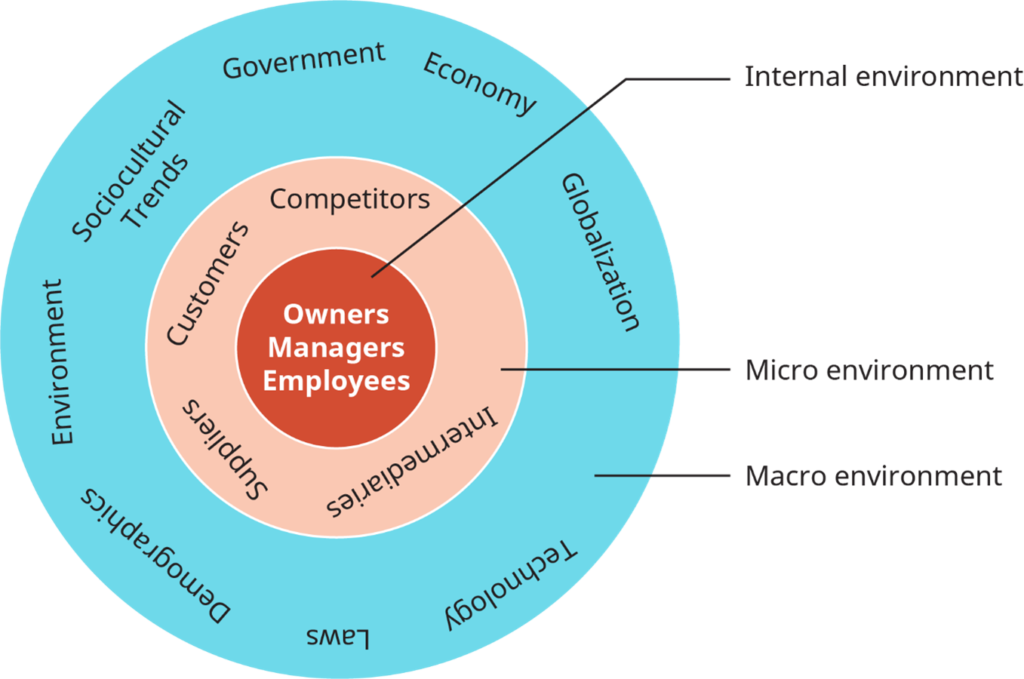
Exhibit 4.2 Components of a Firm’s Environment (Attribution: Copyright Rice University, OpenStax, under CC-BY 4.0 license)
A firm’s macro environment contains elements that can impact the firm but are generally beyond its direct control. These elements are characteristics of the world at large and are factors that all businesses must contend with, regardless of the industry they are in or type of business they are. In the Exhibit 4.2, the macro environment is indicated in blue. Note that the terms contained in the blue ring are all “big-picture” items that exist independently of business activities. That is not to say that they do not affect firms or that firm activities cannot affect macro environmental elements; both can and do happen, but firms are largely unable to directly change things in the macro environment.
Strategists study the macro environment to learn about facts and trends that may present opportunities or threats to their firms. However, they do not usually just think in terms of SWOT. Strategists have developed more discerning tools to examine the external environment.
PESTEL
PESTEL is a tool that reminds managers to look at several distinct categories in the macro environment. PESTEL is an acronym. In this case, the letters represent the categories to examine: political factors, economic factors, sociocultural factors, technological factors, environmental factors, and legal factors. When using PESTEL to analyze a specific firm’s situation, overlap between different categories of PESTEL factors can sometimes happen.
PESTEL can reveal multiple impacts from a single element in the external environment. For example, decreasing interest in car ownership among urban millennials would be a sociocultural trend. However, the technological connectedness of those same urban millennials is exactly what makes it possible for ride-sharing services such as Uber and Lyft to thrive: their services are app based and provide convenience both by connecting drivers and passengers quickly and by making transactions cashless.
Exhibit 4.3 illustrates the components of PESTEL, which will be discussed individually below.
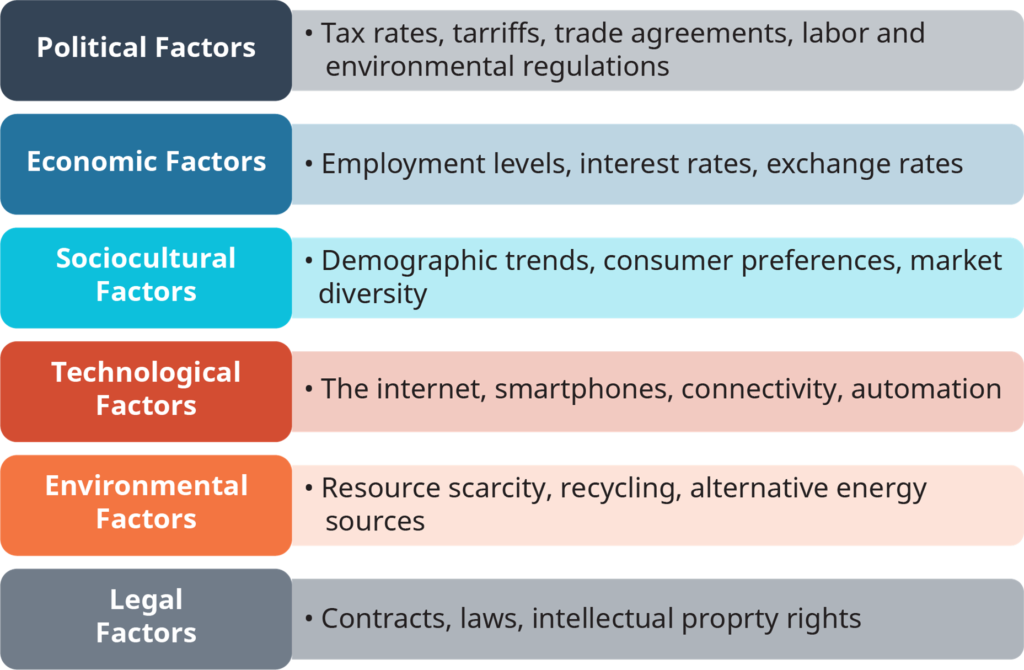
Exhibit 4.3 The PESTEL Model for External Environmental Analysis (Attribution: Copyright Rice University, OpenStax, under CC-BY 4.0 license)
Political Factors
Political factors in the macro environment include taxation, tariffs, trade agreements, labor regulations, and environmental regulations. Note that in PESTEL, factors are not characterized as opportunities or threats. They are simply things that a firm can take advantage of or treat as problems, depending on its own interpretation or abilities. American Electric Power, a large company that generates and distributes electricity, may be negatively impacted by environmental regulations that restrict its ability to use coal to generate electricity because of pollution caused by burning coal. However, another energy firm has taken advantage of the government’s interest in reducing coal emissions by developing a way to capture the emissions while producing power. The Petra Nova plant, near Houston, was developed by NRG and JX Nippon, who received Energy Department grants to help fund the project.6 Although firms do not directly make government policy decisions, many industries and firms invest in lobbying efforts to try to influence government policy development to create opportunities or reduce threats.
Economic Factors
All firms are impacted by the state of the national and global economies. The increased interdependence of individual country economies has made evaluating the economic factors in a firm’s macro environment more complex. Firms analyze economic indicators to make decisions about entering or exiting geographic markets, investing in expansion, and hiring or laying off employees. Employment rates, for example, impact the quantity, quality, and cost of employees available to firms. Interest rates impact sales of big-ticket items that consumers normally finance, such as appliances, cars, and homes. Interest rates also impact the cost of capital for firms that want to invest in expansion. Exchange rates present risks and opportunities to all firms that operate across national borders, and the price of oil impacts many industries, from airlines and transportation companies to solar panel producers and plastic recycling companies. Once again, any scenario can be a threat to one firm and an opportunity to another, so economic forces should not be assumed to be intrinsically good or bad.
Sociocultural Factors
Quite possibly the largest category of macro environmental factors an analyst might examine are sociocultural factors. This broad category encompasses everything from changing national demographics to fashion trends and many things in between. Demographics, a subset of this category, includes facts about income, education levels, age groups, and the ethnic and racial composition of a population. All of these facts present market challenges and possibilities. Firms can target products to specific market segments by studying the needs and preferences of demographic groups, such as working women (they might need day-care services but not watch daytime television), college students (who would be interested in affordable textbooks but couldn’t afford to buy new cars), or the elderly (who would be willing to pay for lawn-mowing services but might not be interested in adventure tourism).
Changes in people’s values and interests are also included in this category. Environmental awareness has spurred demand for solar panels and electric and hybrid cars. A general interest in health and fitness has created industries in gyms, home gym equipment, and organic food. The popularity of social media has created an enormous demand for instant access to information and services, not to mention smartphones. Values and interests are constantly changing and vary from country to country, creating new market opportunities as well as communication challenges for companies trying to enter unfamiliar new markets.
Technological Factors
The rise of the Internet may be the most disruptive technological change of the last century. The globe has become more interconnected and interdependent because of the fast, low-cost communications the Internet provides. Customer service agents in India can serve customers in Kansas because technology has advanced to the point that the customer’s account information can be instantly accessed by the service provider in India. Entrepreneurs around the world can reach customers anywhere through companies such as eBay, Alibaba, and Etsy, and they can get paid, regardless of their customers’ currency, through PayPal. The Internet has enabled Jeff Bezos, who started an online bookselling company called Amazon in 1994, to transform how consumers shop for goods.
Automation has increased efficiency for manufacturers. MRP (materials requirement planning) systems have changed how companies and their suppliers work together, and global-positioning technology has helped construction engineers manage large projects more accurately. Consumers and firms have nearly unlimited access to information, and this access has empowered consumers to make more-informed buying decisions and challenged firms to develop ways to analyze the large amounts of data their businesses generate.
Environmental Factors
The physical environment, which provides natural resources for manufacturing and energy production, has always been a key part of human business activity. As resources become scarcer and more expensive, environmental factors impact businesses more every day. Firms are developing technology to operate more cleanly and using fewer resources. Political pressure on businesses to reduce their impact on the natural environment has increased globally and dramatically in the 21st century. In 2017, London, Barcelona, and Paris announced their plans to ban cars with internal combustion engines over the next few decades, in order to combat air-quality issues.7
This external environment category often overlaps with others in PESTEL because concern for the environment is also a sociocultural trend, as more consumers look for recycled products and buy electric and hybrid cars. On the political front, firms are facing increased regulation around the world on their carbon emissions and natural resource use.
Legal Factors
Legal factors in the external environment often coincide with political factors because laws are enacted by government entities. This does not mean that the categories identify the same issues, however. Although labor laws and environmental regulations have deep political connections, other legal factors can impact business success. For example, in the streaming video industry, licensing fees are a significant cost for firms. Netflix pays billions of dollars every year to movie and television studios for the right to broadcast their content. In addition to the legal requirement to pay the studios, Netflix must consider that consumers may find illegal ways to view the movies they want to see, making them less willing to pay to subscribe to Netflix. Intellectual property rights and patents are major issues in the legal realm.
Note that some external factors are difficult to categorize in PESTEL. For instance tariffs can be viewed as either a political or economic factor while the influence of the internet could be viewed as either a technological or social factor. While some issues can overlap two or more PESTEL areas, it does not diminish the value of PESTEL as an analytical tool.
Concept Check
- Describe a firm’s macro environment.
- What does PESTEL stand for? How do managers use PESTEL to understand their firm’s macro environment?
4.3 A Firm’s Micro Environment: Porter’s Five Forces
- What makes up a firm’s external micro environment, and what tools do strategists use to understand it?
A firm’s micro environment is also illustrated in Exhibit 4.2. These entities are all directly connected to the firm in some way, and firms must understand the micro environment in order to successfully compete in an industry. All firms are part of an industry—a group of firms all making similar products or offering similar services, for example automobile manufacturers or airlines. Firms in an industry may or may not compete directly against one another, as we’ll discuss shortly, but they all face similar situations in terms of customer interests, supplier relations, and industry growth or decline.
Harvard strategy professor Michael Porter developed an analysis tool to evaluate a firm’s micro environment. Porter’s Five Forces is a tool used to examine different micro-environmental groups in order to understand the impact each group has on a firm in an industry (Exhibit 4.4). Each of the forces represents an aspect of competition that affects a firm’s potential to be successful in its industry.
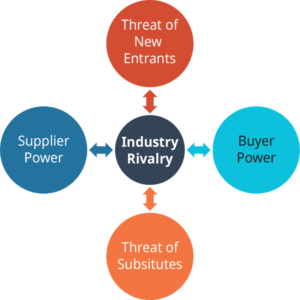
Exhibit 4.4 Porter’s Five Forces Model of Industry Competition (Attribution: Copyright Rice University, OpenStax, under CC-BY 4.0 license)
Industry Rivalry
Industry rivalry, the first of Porter’s forces, is in the center of the diagram. Note that the arrows in the diagram show two-way relationships between rivalry and all of the other forces. This is because each force can affect how hard firms in an industry must compete against each other to gain customers, establish favorable supplier relationships, and defend themselves against new firms entering the industry.
When using Porter’s model, an analyst will determine if each force has a strong or weak impact on industry firms. In the case of rivalry, the question of strength focuses on how hard firms must fight against industry rivals (competitors) to gain customers and market share. Strong rivalry in an industry reduces the profit potential for all firms because consumers have many firms from which to purchase products or services and can make at least part of their purchasing decisions based on prices. An industry with weak rivalry will have few firms, meaning that there are enough customers for everyone, or will have firms that have each staked out a unique position in the industry, meaning that customers will be more loyal to the firm that best meets their particular needs.
The Threat of New Entrants
In an industry, there are incumbent (existing) firms that compete against each other as rivals. If an industry has a growing market or is very profitable, however, it may attract new entrants. These either are firms that start up in the industry as new companies or are firms from another industry that expand their capabilities or target markets to compete in an industry that is new to them.
Different industries may be easier or harder to enter depending on barriers to entry, factors that prevent new firms from successfully competing in the industry. Common barriers to entry include cost, brand loyalty, and industry growth. For example, the firms in the airline industry rarely face threats from new entrants because it is very expensive to obtain the equipment, airport landing rights, and expertise to start up a new airline.
Brand loyalty can also keep new firms from entering an industry, because customers who are familiar with a strong brand name may be unwilling to try a new, unknown brand. Industry growth can increase or decrease the chances a new entrant will succeed. In an industry with low growth, new customers are scarce, and a firm can only gain market share by attracting customers of other firms. It is important to note that barriers to entry are not always external, firms often lobby politicians for regulations that can be a barrier to entry.
Threat of Substitutes
In the context of Porter’s model, a substitute is any other product or service that can satisfy the same need for a customer as an industry’s offerings. Be careful not to confuse substitutes with rivals. Rivals offer similar products or services and directly compete with one another. Substitutes are completely different products or services that consumers would be willing to use instead of the product they currently use. For example, the fast food industry offers quickly prepared, convenient, low-cost meals. Customers can go to McDonald’s, Wendy’s, Burger King, or Taco Bell—all of these firms compete against each other for business. However, their customers are really just hungry people. What else could you do if you were hungry? You could go to the grocery store and buy food to prepare at home. McDonald’s does not directly compete against Kroger for customers, because they are in different industries, but McDonald’s does face a threat from grocery stores because they both sell food. How does McDonald’s defend itself from the threat of Kroger as a substitute? By making sure their food is already prepared and convenient to purchase—your burger or salad is ready to eat and available without even getting out of your car.

Exhibit 4.5 McDonalds A drive-through menu at this McDonald’s is designed to help customers choose their meal quickly and have it ready for pickup at the drive-through window. (Credit: Caribb/ flickr/ Public Domain)
Supplier Power
Virtually all firms have suppliers who sell parts, materials, labor, or products. Supplier power refers to the balance of power in the relationship between firms and their suppliers in an industry. Suppliers can have the upper hand in a relationship if they offer specialized products or control rare resources. For example, when Sony develops a new PlayStation model, it often works with a single supplier to develop the most advanced processor chip it can for their game console. That means its supplier will be able to command a fairly high price for the processors, an indication that the supplier has power. On the other hand, a firm that needs commodity resources such as oil, wheat, or aluminum in its operations will have many suppliers to choose from and can easily switch suppliers if price or quality is better from a new partner. Commodity suppliers usually have low power.
Buyer Power
The last of Porter’s forces is buyer power, which refers to the balance of power in the relationship between a firm and its customers. If a firm provides a unique good or service, it will have the power to charge its customers premium prices, because those customers have no choice but to buy from the firm if they need that product. In contrast, when customers have many potential sources for a product, firms will need to attract customers by offering better prices or better value for the money if they want to sell their products. One protection firms have against buyer power is switching costs, the penalty consumers face when they choose to use a particular product made by a different company. Switching costs can be financial (the extra price paid to choose a different product) or practical (the time or hassle required to switch to a different product). For example, think about your smartphone. If you have an iPhone now, what would be the penalty for you to switch to a non-Apple smartphone? Would it just be the cost of the new phone? Smartphones are not inexpensive, but even when cell phone service providers offer free phones to new customers, many people still don’t switch. The loss of compatibility with other Apple products, the need to transfer apps and phone settings to another system, and the loss of favorite iPhone features, such as iMessage, are enough to keep many people loyal to their iPhones.
Concept Check
- Describe each of Porter’s Five Forces. What information does each provide a manager trying to understand her firm’s micro environment?
4.4 The Internal Environment and Using SWOT for Strategic Analysis
- How and why do managers conduct an internal analysis of their firms?
A firm’s internal environment is illustrated in Exhibit 4.2 by the innermost circle. The internal environment consists of members of the firm itself, investors in the firm, and the assets a firm has. Employees and managers are good examples; they are firm members who have skills and knowledge that are valuable assets to their firms. Evaluating a firm’s internal environment is not just a matter of counting heads, however. Successful firms have a wide range of resources and capabilities that they can use to maintain their success and grow into new ventures. A thorough analysis of a firm’s internal situation provides a manager with an understanding of the resources available to pursue new initiatives, innovate, and plan for future success.
Resources and Capabilities
A firm’s resources and capacities are the unique skills and assets it possesses. Resources are things a firm has to work with, such as equipment, facilities, raw materials, employees, and cash. Capabilities are things a firm can do, such as deliver good customer service or develop innovative products to create value. Both are the building blocks of a firm’s plans and activities, and both are required if a firm is going to compete successfully against its rivals. Firms use their resources and leverage their capabilities to create products and services that have some advantage over competitors’ products. For example, a firm might offer its customers a product with higher quality, better features, or lower prices. Not all resources and capabilities are equally helpful in creating success, though. Internal analysis identifies exactly which assets bring the most value to the firm.
SWOT
What is a SWOT analysis, and what can it reveal about a firm?
You may already have heard of one very common tool firms use to analyze their strategic and competitive situations: SWOT, which is an acronym for strengths, weaknesses, opportunities, and threats. Firms use SWOT analysis to get a general understanding of what they are good or bad at and what factors outside their doors might present chances for success or difficulty. Let’s take a look at SWOT analysis piece by piece (Exhibit 4.6).
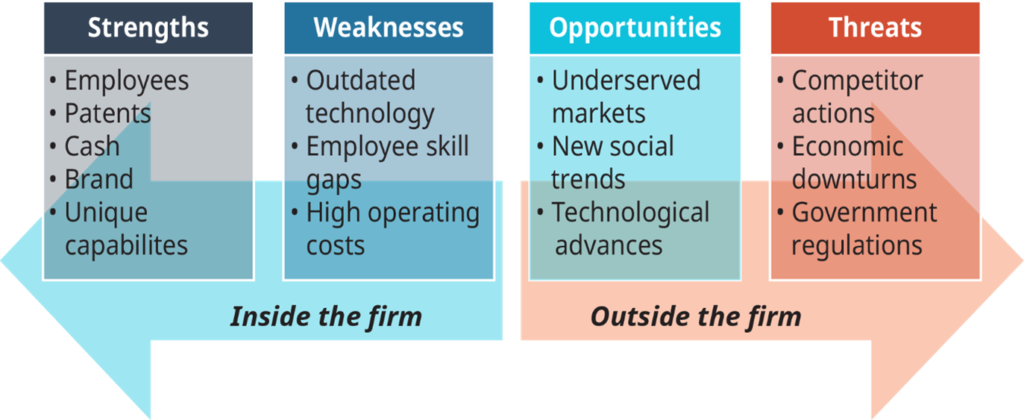
Exhibit 4.6 The Components of SWOT (Attribution: Copyright Rice University, OpenStax, under CC-BY 4.0 license)
Strengths
A firm’s strengths are, to put it simply, what it is good at. Nike is good at marketing sports products, McDonald’s is good at making food quickly and inexpensively, and Ferrari is good at making beautiful fast cars. When a firm analyzes its strengths, it compiles a list of its capabilities and assets. Does the firm have a lot of cash available? That is a strength. Does the firm have highly skilled employees? Another strength. Knowing exactly what it is good at allows a firm to make plans that exploit those strengths. Nike can plan to expand its business by making products for a sport it doesn’t currently serve. Its sports marketing expertise will help it successfully launch that new product line.
Weaknesses
A firm’s weaknesses are what it is not good at—things that it does not have the capabilities to perform well. Weaknesses are not necessarily faults—remember that not all firms can be great at all things. When a firm understands its weaknesses, it will avoid trying to do things it does not have the skills or assets to succeed in, or it will find ways to improve its weaknesses before undertaking something new. A firm’s weaknesses are simply gaps in capabilities, and those gaps do not always have to be filled within the firm.
SWOT analysis alerts firms to the gaps in their capabilities so they can work around them, find help in those areas, or develop capabilities to fill the gaps. For example, Paychex is a firm that handles payroll for over 600,000 firms.5 Paychex processes hours, pay rates, tax and benefits deductions, and direct deposit for firms that would rather not have to perform those tasks themselves. A large firm would need to have a team of employees dedicated to fulfilling that task and equip that team with software systems to do the job efficiently and accurately. For Paychex, these capabilities are a company strength—that’s what it does. Other companies that do not have the resources to develop this capability or may not be interested in doing so can hire Paychex to do the job for them.
Opportunities
While strengths and weaknesses are internal to an organization, but opportunities and threats are always external. An opportunity is a potential situation that a firm is equipped to take advantage of. Think of opportunities in terms of things that happen in the market. Opportunities offer positive potential, however sometimes a firm is not equipped to take advantage of an opportunity which is why considering the entire SWOT is important before deciding what to do. For example, as cities are becoming more populated, parking is becoming scarcer. Younger consumers who live in cities are starting to question whether it makes sense to own a car at all, when public transportation is available and parking is not. Sometimes, however, a person might need a car to travel outside the city or transport a special purchase. Daimler, the manufacturer of Mercedes-Benz and Smart cars, started a car-sharing service in Europe, North America, and China called Car2Go to offer cars to this new market of part-time drivers. By establishing Car2Go, Daimler has found a way to sell the use of its products to people who would not buy them outright.
Threats
When a manager assesses the external competitive environment, they label anything that would make it harder for their firm to be successful as a threat. A wide variety of situations and scenarios can threaten a firm’s chances of success, from a downturn in the economy to a competitor launching a better version of a product the firm also offers. A good threat assessment looks thoroughly at the external environment and identifies threats to the firm’s business so it can be prepared to meet them. Opportunities and threats can also be a matter of perspective or interpretation: the Car2Go service that Daimler developed to serve young urban customers who don’t own cars could also be cast as a defensive response to the trend away from car ownership in this customer group. Daimler could have identified decreasing sales among young urban professionals as a threat and developed Car2Go as an alternative way to gain revenue from these otherwise lost customers.
The Limitations of SWOT Analysis
Although a SWOT analysis can identify important factors and situations that affect a firm, it only works as well as the person doing the analysis. SWOT can generate a good evaluation of the firm’s internal and external environments, but it is more likely to overlook key issues because it is difficult to identify or imagine everything that could, for example, be a threat to the firm. A SWOT also need to be specific enough to be useful to the firm. If it’s so generic that it could be applied to any number of businesses, it won’t be helpful in determining the strategic pathway forward.
Concept Check
- Explain the elements of a SWOT analysis.
- What information does a SWOT analysis provide managers? What information might it miss?
Managing Change
Technology and Innovation: Uber, Lyft, and the Self-Driving Car: The Transportation of the Future Is Coming Soon
Although the ride-sharing industry is still relatively new, it has seen explosive growth, and its two main rivals, Uber and Lyft, are looking for ways to increase their capacity to serve riders. Both firms, and rivals like them, operate in basically the same way. A person needing a ride uses a smartphone app to alert a nearby person with a car of their location. The driver, usually an independent contractor for the service (meaning they are just a person with a car that has signed up to provide rides in exchange for a portion of the fare the customer pays), picks up the customer and drives them to their destination. Paying for the ride is also handled through the app, and the driver receives about 75–80% of the fare, with Uber or Lyft keeping the balance.12

Exhibit 4.7 Rideshare pickup area The ride-share pickup area at Pierre Elliott Trudeau Airport in Montreal. Due to the popularity of ride sharing with companies such as Uber and Lyft, municipalities and airports have had to accommodate the changing demands of customers. (Credit: Quinn Dombroski/ flickr/ Attribution-ShareAlike2.0 Generic (CC BY-NC 2.0))
The popularity of ride-sharing services has soared, and both companies are constantly recruiting more drivers. However, both companies have also explored alternatives to independent drivers: self-driving cars. Uber and Lyft have taken different paths to develop this capability. Uber has worked to internally develop its own software technology and self-driving car technology, while Lyft has focused on software interfaces that can accommodate other companies’ self-driving cars.13 Lyft’s partnerships with firms such as Google and GM that are already developing self-driving cars has put it ahead of Uber in the race to get driverless vehicles into its ride-sharing network, and it was able to test self-driving cars in Boston by partnering with NuTonomy in 2017.14 Lyft offered a demonstration to journalists at the Consumer Electronics Show in Las Vegas in 2018, offering rides in self-driving cars developed by Aptiv.15 Uber had been testing similar technology in Pittsburgh but suspended its self-driving car program after a fatal pedestrian accident in Arizona.16
Sources: Ridester (2017). “How Much do Uber Drivers Actually Make? The Inside Scoop.” Ridester.com. https://www.ridester.com/how-much-do-uber-drivers-make/ Accessed July 29, 2017; Bensinger, Greg (2017). “Lyft Shifts Gears With New Driverless-Car Division; San Francisco company to hire hundreds of engineers and open new Silicon Valley office.” The Wall Street Journal. July 21, 2017; Edelstein, Stephen (2017). “Lyft Finally Launches Its Boston Self-Driving Car Pilot Program.” The Drive. Dec. 17, 2017. http://www.thedrive.com/tech/16779/lyft-finally-launches-its-boston-self-driving-car-pilot-program; O’Kane, Sean (2018). “I took a gamble by riding in a self-driving Lyft in Las Vegas.” The Verge. January 8, 2018. https://www.theverge.com/2018/1/8/16860590/self-driving-lyft-las-vegas-ces-2018; and Korosec, Kristen (2018). “Uber self-driving cars back on public roads, but in manual mode/” Tech Crunch. July 24, 2018. https://techcrunch.com/2018/07/24/uber-self-driving-cars-back-on-public-roads-but-in-manual-mode/.
Critical Thinking Questions
- What resource or capability challenges have Uber and Lyft faced because their fast company growth?
- What PESTEL factors do you think are contributing to the popularity of ride-sharing services?
- What industry challenges (think of Porter’s Five Forces) does the use of self-driving cars address?
4.5 Competition, Strategy, and Competitive Advantage
- What does it mean to compete with other firms in a business environment, what does it mean when a firm has a competitive advantage over its rivals, and what generic strategies can a firm implement to gain advantage over its rivals?
Now that you understand more about the environment that businesses operate in, let’s take a deeper look at exactly how they operate. Businesses exist to make profits by offering goods and services in the marketplace at prices that are higher than the costs they incurred creating those goods and services. Businesses rarely exist alone in an industry; competition is a usually a key part of any marketplace. This means that businesses must find ways to attract customers to their products and away from competitors’ products. Strategy is the process of planning and implementing actions that will lead to success in competition.
The analytical tools we discuss here are part of the strategic planning process. Managers cannot successfully plan to compete in an industry if they don’t understand its competitive landscape. It is also unlikely that a firm planning to launch a new product they are not equipped to make will be successful.
Competition
Porter’s Five Forces model is centered around rivalry, a synonym for competition. In any industry, multiple firms compete against each other for customers by offering better or cheaper products than their rivals. Firms use PESTEL to understand what consumers are interested in and evaluate their own resources and capabilities so that they can figure out how to offer products and services that match those consumer interests and that are better in quality and price than the products offered by their competitors.
A firm is described as having a competitive advantage when it successfully attracts more customers, earns more profit, or returns more value to its shareholders than rival firms do. A firm achieves a competitive advantage by adding value to its products and services or reducing its own costs more effectively than its rivals in the industry.
Generic Business-Level Competitive Strategies
When discussing business strategy, a business is a firm or a unit of a firm that centers its activities around one primary type of product or service line. Business-level strategy is the general way that a business organizes its activities to compete against rivals in its product’s industry. Michael Porter (the same Harvard professor who developed the Five Forces Model) defined three generic business-level strategies that outline the basic methods of organizing to compete in a product market. He called the strategies “generic” because these ways of organizing can be used by any firm in any industry.
Cost Leadership
When pursuing a cost-leadership strategy, a firm offers customers its product or service at a lower price than its rivals can. To achieve a competitive advantage over rivals in the industry, the successful cost leader tightly controls costs throughout its value chain activities. Supplier relationships are managed to guarantee the lowest prices for parts, manufacturing is conducted in the least expensive labor markets, and operations may be automated for maximum efficiency. A cost leader must spend as little as possible producing a product or providing a service so that it will still be profitable when selling that product or service at the lowest price. Walmart is the master of cost leadership, offering a wide variety of products at lower prices than competitors because it does not spend money on fancy stores, it extracts low prices from its suppliers, and its pays its employees relatively low wages.
Differentiation
Not all products or services in the marketplace are offered at low prices, of course. A differentiation strategy is exactly the opposite of a cost-leadership strategy. While firms do not look to spend as much as possible to produce their output, firms that differentiate try to add value to their products and services so they can attract customers who are willing to pay a higher price. At each step in the value chain, the differentiator increases the quality, features, and overall attractiveness of its products or services. Research and development efforts focus on innovation, customer service is excellent, and marketing bolsters the value of the firm brand. These efforts guarantee that the successful differentiator can still profit even though its production costs are higher than a cost leader’s. Starbucks is a good example of a differentiator: it makes coffee, but its customers are willing to pay premium prices for a cup of Starbucks coffee because they value the restaurant atmosphere, customer service, product quality, and brand.
Porter’s typology assumes that firms can succeed through either cost leadership or differentiation. Trying to combine these two, Porter suggests, can lead to a firm being stuck in the middle.
Focus
Porter’s third generic competitive strategy, focus, is a little different from the other two. A firm that focuses still must choose one of the other strategies to organize its activities. It will still strive to lower costs or add value. The difference here is that a firm choosing to implement a focused strategy will concentrate its marketing and selling efforts on a smaller market than a broad cost leader or differentiator. A firm following a focus-differentiation strategy, for example, will add value to its product or service that a few customers will value highly, either because the product is specifically suited to a particular use or because it is a luxury product that few can afford. For example, Flux is a company that offers custom-made bindings for your snowboard. Flux is a focus differentiator because it makes a specialized product that is valued by a small market of customers who are willing to pay premium prices for high-quality, customized snowboarding equipment.

Exhibit 4.8 Snowboard bindings The Flux premium bindings on this snowboard are an example of a product on a focus-driven company. Snowboard bindings are the only products Flux markets. (Credit: Ted and dani Percival/ flickr/ Attribution 2.0 Generic (CC BY 2.0))
Concept Check
- What is competition, and what is the role of strategy in competition?
- When does a firm have a competitive advantage over its rivals?
- Explain the differences between the three business-level generic competitive strategies.
4.6 Strategic Positioning
- What elements go into determining a firm’s strategic position?
A manager who has done all of the analysis described so far in this chapter has some decisions to make based on all of the information the analysis has revealed. A firm’s decisions on how to serve customers and compete against rivals is called strategic positioning. In order to develop its position, a firm combines its understanding of the competitive environment, including the firm’s own resources and capabilities, its industry situation, and facts about the macro environment. A strategic position includes a choice of generic competitive strategy, which a firm selects based on its own capabilities and in response to the positions already staked out by its industry rivals. The firm also determines which customers to serve and what those customers are willing to pay for. A strategic position also includes decisions about what geographic markets to participate in.
Most importantly, a firm’s strategic position should try to be unique in some way that competitors cannot imitate quickly or easily. Competitive advantage is achieved when a firm attracts more customers or makes more profit than rivals. This cannot happen unless the firm organizes its activities to provide customers with better value than rivals.
Now, we’re planning!
Concept Check
How does strategic analysis help a firm develop its own strategic position?
Key Terms
barriers to entry
Industry factors (such as high start-up costs) that can prevent new firms from successfully launching new operations in that industry.
buyer power
In the relationship between a firm and its customers, buyers with high power can negotiate product price or features, while buyers with low power cannot.
capabilities
A firm’s skill at coordinating and leveraging resources to create value.
competition
Business actions a firm undertakes to attract customers to its products and away from competitors’ products.
competitive advantage
When a firm successfully attracts more customers, earns more profit, or returns more value to its shareholders than rival firms do.
competitive environment
Factors and situations both inside the firm and outside the firm that have the potential to impact its operations and success.
cost-leadership strategy
A generic business-level strategy in which a firm tightly controls costs throughout its value chain activities in order to offer customers low-priced goods and services at a profit.
demographics
Part of PESTEL that includes facts about the income, education, age, and ethnic and racial composition of a population.
differentiation strategy
A generic business-level strategy in which firms add value to their products and services in order to attract customers who are willing to pay a higher price.
economic factors
PESTEL category that includes facts (such as unemployment rates, interest rates, and commodity prices) about the state of the local, national, or global economy.
environmental factors
PESTEL category that examines a firm’s external situation with respect to the natural environment, including pollution, natural resource availability and preservation, and alternative energy.
environmental scanning
The systematic and intentional analysis of a firm’s internal state and its external environment.
external environment
The aspects of the world at large and of a firm’s industry that can impact its operations.
external factors
Things in the world or industry environments that may impact a firm’s operations or success, such as the economy, government actions, or supplier power. Strategic decisions can be made in response to these things but normally cannot directly influence or change them.
focus strategy
A generic business-level competitive strategy that firms use in combination with either a cost-leadership or differentiation strategy in order to target a smaller demographic or geographic market with specialized products or services.
generic business-level strategies
Basic methods of organizing firm value chain activities to compete in a product market that can be used by any sized firm in any industry.
industry
A group of firms all offering products or services in a single category, for example restaurants or athletic equipment.
industry rivalry
One of Porter’s Five Forces; refers to the intensity of competition between firms in an industry.
internal environment
Innermost layer of a firm’s competitive environment, including members of the firm itself (such as employees and managers), investors in the firm, and the resources and capabilities of a firm.
internal factors
Characteristics of a firm itself, such as resources and capabilities, that the firm can use to successfully compete against its rivals.
legal factors
In PESTEL, the laws impacting business, such as those governing contracts and intellectual property rights and illegal activities, such as online piracy.
macro environment
The outermost layer of elements in a firm’s external environment that can impact a business but are generally beyond the firm’s direct control, such as the economy and political activity.
micro environment
The middle layer of elements in a firm’s external environment, primarily concerned with a firm’s industry situation.
new entrants
One of Porter’s Five Forces, the threat of new entrants assesses the potential that a new firm will start operations in an industry.
opportunity
A situation that a firm has the resources and capabilities to take advantage of.
PESTEL
A strategic analysis tool that examines several distinct categories in the macro environment: political, economic, sociocultural, technological, environmental, and legal.
political factors
PESTEL factor that identifies political activities in the macro environment that may be relevant to a firm’s operations.
Porter’s Five Forces
Evaluates the interconnected relationships between various actors in an industry, including competing firms, their suppliers, and their customers, by examining five forces: industry rivalry, threat of new entrants, threat of substitutes, supplier power, and buyer power.
primary activities
Firm activities on the value chain that are directly responsible for creating, selling, or servicing a product or service, such as manufacturing and marketing.
resources
Things a firm has, such as cash and skilled employees, that it can use to create products or services.
sociocultural factors
PESTEL category that identifies trends, facts, and changes in society’s composition, tastes, and behaviors, including demographics.
strategic analysis
Process that firms use to study and understand their competitive environment.
strategic positioning
Firm’s decisions on how to organize its actions and operate to effectively serve customers and compete against rivals.
strategy
Process of planning and implementing actions that will lead to success in competition.
strengths
Resources and capabilities of a firm; what it is good at.
substitutes
One of Porter’s Five Forces; products or services outside a firm’s industry that can satisfy the same customer needs as industry products or services can.
supplier power
One of Porter’s Five Forces; describes the balance of power in the relationship between firms in an industry and their suppliers.
SWOT
Strategic analysis tool used to examine a firm’s situation by looking at its strengths, weaknesses, opportunities, and threats.
technological factors
PESTEL category that includes factors such as the Internet, social media, automation, and other innovations that impact how businesses compete or how they manufacture, market, or sell their goods or services.
threat
Anything in the competitive environment that would make it harder for a firm to be successful.
weaknesses
Things that a firm does not have good capabilities to perform or gaps in firm resources.
Summary of Learning Objectives
4.1 Gaining Advantages by Understanding the Competitive Environment
What is strategic analysis, and why do firms need to analyze their competitive environment?
Strategic analysis is a systematic evaluation of a firm’s situation, both internally and with respect to what is happening in the outside world. This analysis examines what the firm itself is good or bad at, how rivals in its industry are competing against it for customers, and what factors in the world environment, such as economic indicators or demographic changes, might impact the firm’s ability to be successful.
Firms need to conduct this analysis in order to be aware of and prepared for changes in their competitive environment and to maximize their chance of successfully competing against rivals and sustaining their profitability and market share in their industry.
4.2 A Firm’s External Macro Environment: PESTEL
What makes up a firm’s external macro environment, and what tools do strategists use to understand it?
The external environment of a firm is composed of two primary layers: the macro environment and the micro environment. The macro environment includes facts and situations that a firm must be aware of but cannot always influence. The macro environment is analyzed using the PESTEL analytical tool that considers a firm’s political and legal aspects, economic indicators, sociocultural trends, demographic facts, technological changes, and environmental aspects.
4.3 A Firm’s Micro Environment: Porter’s Five Forces
What makes up a firm’s external micro environment, and what tools do strategists use to understand it?
The second layer of a firm’s external environment is its micro environment, which includes the components of a firm’s industry, such as competitors, suppliers, and customers. Porter’s Five Forces of industry competition (industry rivalry, threat of new entrants, threat of substitutes, supplier power, and buyer power) capture the dynamic relationships between these components.
4.4 The Internal Environment and Using SWOT for Strategic Analysis
What is a SWOT analysis, and what can it reveal about a firm?
SWOT is a traditional analytical tool that identifies a firm’s strengths, weaknesses, opportunities, and threats (SWOT is an acronym of these four factors). It is useful for conducting a quick look at the internal capabilities (strengths and weaknesses) and external events and situations (opportunities and threats) a firm is facing.
SWOT is not a comprehensive analytical tool, because the four categories for analysis are too broad and will not necessarily identify all of the factors important to a firm’s success that a more thorough analysis would.
4.5 Competition, Strategy, and Competitive Advantage
What does it mean to compete with other firms in a business environment, and what does it mean when a firm has a competitive advantage over its rivals and what generic strategies can a firm implement to gain advantage over its rivals?
Competition is the battle for customers. Firms compete against rivals offering similar products and services and try to attract customers by making sure their product or service is a little better or less expensive than those of their competitors. The firm that is most successful in this battle, measured in terms of profitability or in terms of market share, has a competitive advantage.
Generic competitive strategies are the basic templates for organizing firm activities in order to achieve competitive advantage in an industry. A firm will perform value chain activities, such as marketing and research and development, in order to support the overall competitive strategy it has chosen.
Following a generic cost-leadership strategy requires that a firm try to save money throughout the value chain so that it can offer customers low-priced goods and services. In contrast, differentiators add value to their products and services while performing value chain activities so that they can charge premium prices to consumers.
A third generic competitive strategy, focus, is chosen in combination with one of the other two strategies by firms who decide to target smaller geographic or demographic customer groups.
4.6 Strategic Positioning
What elements go into determining a firm’s strategic position?
A firm develops a strategic position in response to the factors present in its competitive environment. Strategic analysis is essential in identifying and understanding the factors that a strategic position must address. The choice of strategic position factors in a firm’s key resources and capabilities when choosing a generic competitive strategy, product or service to be offered, target market, and geographic reach to compete successfully against rivals in an industry. To be successful in allowing a firm to achieve a competitive advantage in its industry, a firm’s strategic position should be different from its competitors’ positions in the same industry and should be hard for competitors to copy so that the firm’s competitive advantage lasts.
Chapter Review Questions
- Why do managers use strategic analysis?
- What information does a SWOT analysis provide managers? What information might it miss?
- Describe a firm’s macro environment and how managers use PESTEL to understand it.
- What is a firm’s micro environment, and why is it important?
- What is an industry, and how do Porter’s Five Forces help a manager trying to understand a firm’s industry environment?
- When does a firm have a competitive advantage over its rivals?
- What are generic competitive strategies, and how are they implemented in a firm’s value chain activities?
- How does strategic analysis help a firm develop its own strategic position? Why should that position be unique?
Management Skills Application Exercises
Assume that you have been hired by a local small-business consulting firm. You have been asked by your boss to review a proposal from a client who is considering opening a new Pilates and yoga studio in a trendy part of town. Because you know SWOT analysis, you have been asked to group the following attributes about the proposed business into a SWOT analysis:
The proposed location is on the same street corner as the main subway line station and three blocks from a ferry terminal that commuters use go to work.
The proposed location has a vestibule and a new HVAC system.
The street that the location is situated on has many small shops, restaurants, and bars and is a popular gathering place.
There are many historic structures that are in need of updates, but some owners are reluctant to invest in these aging structures.
The area has become gentrified over the past decade, and there is more disposable income than in the past.
In addition to the young professionals, a large number of 55 and over retirees who are now empty nesters have been moving into the neighborhood.
With the young professionals and empty nesters, this area has one of the lowest birth rates in the nation.
The two-year lease is affordable for the business plan, but there is no guarantee of renewal after the term.
There is a rumor of a spin studio opening two blocks away.
The building has been updated with ramps and restrooms to accommodate disabled patrons.
The local paper has interviewed the client and will be running a “Pilates Craze” feature in the upcoming weekend newspaper.
Set up an interview with a manager at a local business who is involved in the strategic planning process at her company. Ask her what type of planning she is involved in (strategic, operational). Discover if she involves the employees who report to her in the planning process and how planning is tied to goal setting. Write a report on your findings. The interview should take no more than 15 minutes.
Managerial Decision Exercises
Select three different businesses from different industries, such as a hospitality business (hotel, restaurant, fitness center), a manufacturing company, and a not-for-profit business. Perform a SWOT analysis for each business.
Perform a quick PESTEL analysis of the companies listed below. What is the largest risk for each of the companies? Assume that you had $100,000 to invest in one of more of these companies. Explain how you would allocate your investment and why you chose this particular allocation.
Uber
Tesla
General Motors
Technology has the ability to disrupt industries. You are involved in an industry that is undergoing change and disruption by taking this class. The traditional textbook industry is being disrupted by the availability of digital textbooks, and free textbooks such as this one are further impacting traditional textbook publishers. Place the following statements into Porter’s Five Forces model.
Students have access to the material at a greatly reduced cost.
Authorship is funded through philanthropic donations rather than royalties paid from textbook sales revenue.
More students have access to the Internet than ever before.
Companies, governments, and students invest large sums of money in their education.
Traditional public educational institutions are adapting their delivery models for online learning.
Private companies such as Apollo (University of Phoenix) are offering lower-cost education options.
Bookstores now offer traditional textbooks as well as used and rental options.
Government legislation is urging faculty to consider lower-cost options.
Critical Thinking Case
Tesla Aims for the Mass Market
Elon Musk cofounded Tesla in 2003 with the vision of making electric cars that could rival, and even replace, traditional gas-engine cars in the consumer marketplace. At the start of the 21st century, the external environment was beginning to show favorable signs for the development of electric cars: people were becoming more concerned about the environment and their carbon footprints, and gas prices were beginning a steep climb that had already spurred the sales of hybrid gas-electric cars such as the Toyota Prius.
The automobile industry was not responding to these environmental trends, instead relying on the fact that trucks such as the Ford F-150 and Chevrolet Silverado were still the two top-selling vehicles in America in 2003. Musk saw a different future for vehicles, and Tesla introduced the all-electric Roadster in 2008. Four years later, the more practical Model S was introduced, and Tesla sales began to climb.
As a new entrant in the automobile industry, though, Tesla faced several challenges. Manufacturing and distribution in this industry are extremely expensive, and Tesla had to develop the capability of efficiently manufacturing large quantities of cars. Tesla also had to establish dealerships for its cars, although it also decided to sell cars online, taking advantage of tech-savvy consumers’ comfort with online shopping. Perhaps Tesla’s greatest challenge was convincing consumers to trust the new technology of all-electric cars. Range anxiety became an actual term, describing people’s fear that their car batteries would run out before they reached their destinations. To combat this, Tesla developed an extensive network of charging stations so consumers could be confident that they could charge their cars conveniently.
Elon Musk has been a master of raising money to fund Tesla’s efforts to successfully enter the mainstream automobile manufacturing industry; so far, Tesla’s entry has cost billions of dollars. Tesla has also taken advantage of tax incentives to develop its charging stations and to sell its cars, because Tesla customers receive tax credits for the purchase of their cars. Tesla cars are not inexpensive, however, and that has limited their marketability. Most Americans cannot afford the Model S or more recent Model X’s high prices (up to and exceeding $100,000).
In 2017, Tesla launched the Model 3, designed to transform the car industry by being its first mass-market, affordable model. The company started taking “reservations” for the model in 2016, promising that it would arrive with a $35,000 price tag. By mid-2017, the reservations list had reached half a million customers, creating a new problem for Tesla. How could it possibly manufacture that many cars when production levels for all of 2016 were less than 84,000 cars?

Exhibit 4.9 Tesla 3 The Tesla Model 3. (Credit: Brian Doyle/ flickr/ Attribution 2.0 Generic (CC BY 2.0))
Critical Thinking Questions
- What PESTEL factors supported Tesla’s success? Which factors posed challenges?
- How has Tesla’s strategic position changed since it was founded in 2003?
- What kind of responses would you expect from Tesla’s rivals in the automobile manufacturing industry to the Model 3’s popularity?
Sources: Tesla company website: https://www.tesla.com/ and investor relations site: http://ir.tesla.com/; Edmunds, “Top 10 Best Selling Cars in 2003.” https://www.edmunds.com/car-reviews/top-10/top-10-best-selling-vehicles-in-2003.html (updated May 12, 2009); Bill Vlasic, “In Pivotal Moment, Tesla Unveils its First Mass Market Sedan.” New York Times, July 29, 2017, https://www.nytimes.com/2017/07/29/business/tesla-model-3-elon-musk.html?ref=business.
Chapter 4 Attributions:
Principles of Management by Bright, D. S., Cortes, A. H., Hartmann, E., Parboteeah, K. P., Pierce, J. L., Reece, M., Shah, A., Terjesen, S., Weiss, J., White, M. A., Gardner, D. G., Lambert, J., Leduc, L. M., Leopold, J., Muldoon, J., & O’Rourke, J. S. Available at OpenStax and licensed under CC BY 4.0.
Waymaker Principles of Management by Lumen Learning. Available at Lumen Learning and licensed under CC BY 4.0.